There’s a bird feeder in my garden. I’ve had it for about a decade now – Ruth got it for me, I think, as a thirtiethbirthday present – and it’s still going strong and mostly-intact, despite having been uprooted on several
occasions to move house.
I like that I can see it from my desk.
A woodpecker’s been a regular visitor this winter.
This month, though, it lost a piece, when one of its seed cages was stolen in a daring daylight heist by a duo of squirrels who climbed up the (“climb-proof”) pole, hung upside-down
from the hooks, and unscrewed the mechanism that held the feeder in place.
Not content to merely pour out and devour the contents, the miscreants made off with the entire feeder cage. It hasn’t been seen since. I’ve scoured the lawn, checked behind
the bushes, peered around bins and fence posts… it’s nowhere to be found. It’s driving me a little crazy that it’s vanished so-thoroughly.
Artists’ recreation of one of the culprits. (Courtesy @mikebirdy.)
I can only assume that the squirrels, having observed that the feeder would routinely be refilled once empty, decided that it’d be much more-convenient for them if it the feeder were
closer to their home:
“Hey, Coco!”
“Yeah, Peanut?”
“Every time we steal the nuts in this cage, more nuts appear…”
“Yeah, it’s a magic cage. Everysquirrel knows that, Peanut!”
“…but we have to come all the way down here to eat them…”
“It’s a bit of a drag, isn’t it?”
“…so I’ve been thinking, Coco: wouldn’t it be easier if the cage was… in our tree?”
Scene of the crime.
I like to imagine that the squirrels who live in whatever-tree the feeder’s now hidden in are in the process of developing some kind of cargo cult around it. Once a week, squirrels sit
and pray at the foot of the cage, hoping to appease the magical god who refills it. Over time, only the elders will remember seeing the feeder ever being full, and admonish their
increasingly-sceptical youngers ones to maintain their disciplined worship. In decades to come, squirrel archaeologists will rediscover the relics of this ancient (in squirrel-years)
religion and wonder what inspired it.
Or maybe they dumped the feeder behind the shed. I’d better go check.
I was visited this morning by a pair of Jehovah’s Witnesses, doing the door-to-door ministry for which they’re most-famous, and I was reminded of an interesting quirk in the practices
of the WTS. If you know anything at all about their beliefs, you’re probably aware that
Jehovah’s Witnesses generally refuse blood transfusions.
Commenting on religions while belonging to none of them? That’s me. I don’t see this as a problem; I almost see it as an advantage. I couldn’t find a picture to express that, though,
so you get this one.
I first became aware of their policy of rejecting potentially life-saving blood when I was just a child. A school friend of mine (this one!), following
a problematic tonsillectomy, found his life at risk because of his family’s commitment to this religious principle. Because I’ve always been interested in religion and the diversity of
theological difference I ended up looking into the background of their practice… and I came to a very different scriptural interpretation.
Nowadays, the Jehovah’s Witnesses use their own translation, the New World Bible. I don’t have a copy, but I’m choosing to ignore it because the relevant prohibitions predate its
publication anyway.
I hadn’t noticed until after my visitors left that I’d answered the door wearing a pride flag on my t-shirt. (Their opinion on queerness is wrong about for moral, rather than scriptural, reasons.)
Everything that lives and moves about will be food for you. Just as I gave you the green plants,
I now give you everything.But you must not eat meat that has its lifeblood still in it.
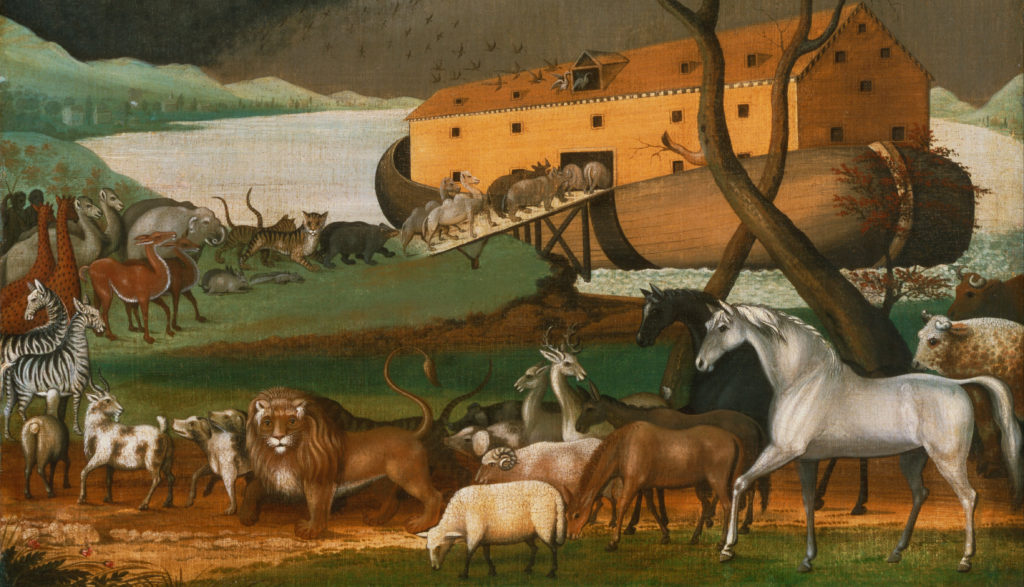
This is God speaking to Noah, by the way. Sexacentenarian Noah’s took a six-week cruise on a floating zoo and God’s just said “boat number 1, your time is up… and by Me you’d better be
horny ‘cos it’s time to go forth and multiply.” God invents the rainbow as a promise not to reformat-and-reinstall again, and then follows it up with a handful of rules because He’s a
big fan of rules. And even though blood transfusions wouldn’t be invented for thousands of years, the Jehovah’s Witnesses almost-uniquely feel that this prohibition on consuming blood
covers transfusions too.
That all sounds fair enough. I mean, it requires a pretty heavy-handed interpretation of what was meant but that’s par for the course for the Bible and especially the Old
Testament.
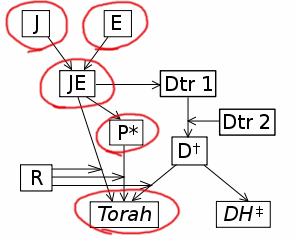
The genesis of Genesis. You can quickly find your way into a rabbit hole of these kinds of diagrams if you’re silly enough to ask questions like “but what’s the original
translation?”
But let’s take a step back. Here’s those verses again, this time in Hebrew:
Every moving living thing is your food, like the plants you were already given. But you may not eat any creature that is still alive.
“Still alive?” That’s a very different way of reading it, right? Suddenly this strange verse about abstaining from, I don’t know, black pudding (and possibly blood
transfusions) becomes a requirement to kill your dinner before you chow down.
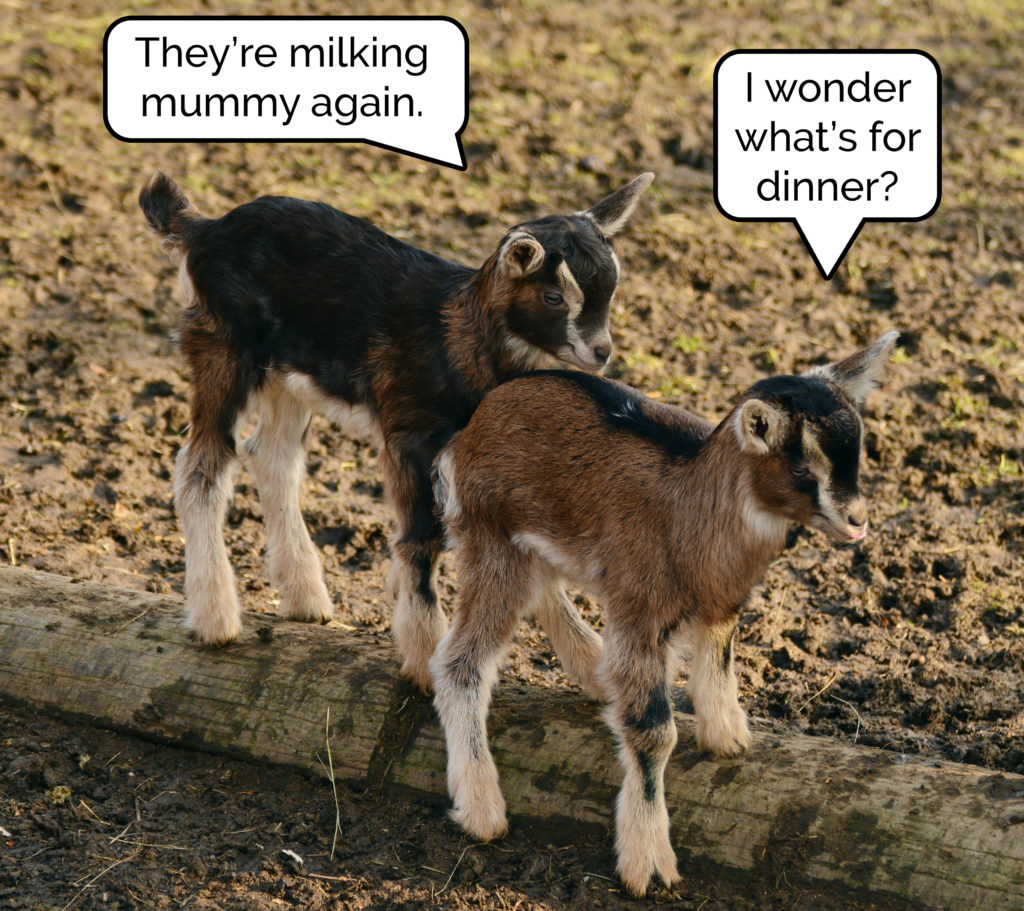
This is like Deuteronomy 14:21, where it says “Do not cook a
young goat in its mother’s milk.” The same directive appears in Exodus 34:26 but I
prefer Deuteronomy’s because it also has this really surreal bit about how it’s not okay to eat roadkill but you can serve it to your immigrant friends. It turns out that kid-boiled-in-mother’s-milk was an old Canaan recipe and pagan tribes used to eat it ritualistically, so
a prohibition on the practice by Noah and his descendants was not only an opposition to animal cruelty but a statement against polytheism.
“Kids! It’s dinnertime!”
Could “eating things alive”, which is specifically forbidden in Judaism, be – like goat-in-goat-juice – another pagan ritual, formerly widespread, that the early Israelites
were trying to outlaw? Quite possibly.
But there’s a further possible interpretation that I feel is worth looking at. Let’s paint a picture. Again, let’s assume despite the mountains of evidence to the contrary that the bible is literally true, which meets people who use the
covenant of Genesis as a basis for medical decisions much more than half-way:
God’s just declared bankruptcy on his first “Earth” project and wiped the slate clean. He’s had the RNG – I’m assuming that God
plays dice – roll up a new landmass, and he’s populated it with one family of humans, plus two of every kind of land animal. Possibly more of the fast breeders like the insects and some
of the small mammals, I suppose, depending on how closely they were housed in the ark. Don’t make me explain this to you.
Shem: “What do you want for lunch?”
Japheth: “Ham.”
Ham: “Gulp.”
Japheth: “No, I mean a pig.”
Ham: “We’ve only got two left. Let’s just smoke some kush instead; God gave dad all the plants.”
Cush: “Did somebody say my name?”
Let’s assume that God doesn’t want the disembarking humans to immediately eat all of the animals with no concern for sustainability. This is, of course, absolutely what we humans do: if
we take a biblical-literalism viewpoint, it’s a miracle that the delicious dodo would last until the 17th century CE rather than being eaten
on the first post-flood day. God’s sort-of promised that the humans will be allowed to eat almost anything they like and that He’ll stop meddling, but He doesn’t want a mass-extinction,
so what does He do? He says:
You can eat all the plants you want. But don’t eat any of the animals that are alive right now: let them breed a bit first.
This has always seemed to me to be the obvious way to interpret the commandment not to eat living animals: don’t eat the ones that are living at the moment. Certainly
more-rational than “don’t have blood transfusions.” And if what God (allegedly) said to Noah is to be treated as a rule that still stands today, rather than just at the time, then
perhaps it’s vegetarianism for which Jehovah’s Witnesses should best be known. That way, they’d get to argue with the hosts of barbecues about what goes into their bodies rather
than with judges about
what goes into their childrens’.
But try telling them that. (Seriously: give it a go! They’re usually more than happy to talk about scripture, even if you’re a little bit sarcastic!)
See the @NYTimes story about how Dutch church @BethelDenHaag has been holding a non-stop six-week service in order to prevent the deportation of a family taking refuge within?
…[A] marathon church service, which started more than six weeks ago, and hasn’t stopped since, can never take a break.
Under an obscure Dutch law, the police may not disrupt a church service to make an arrest. And so for the past six weeks, immigration officials have been unable to enter Bethel Church
to seize the five members of the Tamrazyan family, Armenian refugees who fled to the sanctuary to escape a deportation order.
The service, which began in late
October as a little-noticed, last-gasp measure by a small group of local ministers, is now a national movement, attracting clergy members and congregants from villages and cities
across the Netherlands. More than 550 pastors from about 20 denominations have rotated through Bethel Church, a nonstop service all in the name of protecting one vulnerable family.
…
Beautiful story of the Dutch church that’s been running a non-stop service (with over 500 pastors from various denominations contributing in shifts) for six weeks and counting in order
to protect from deportation a family who’ve been taking refuge inside. The whole piece
is well worth your time to read, but aside from the general joy and good feels that fill it, I was also impressed by how widely it’s inspired preachers to try things that are a little
different:
Some preachers simply reuse services and sermons they gave at other churches. But others have used the opportunity to try something new, turning the church into a kind of greenhouse
for liturgical experiments.
Ms. Israel read from a modern reinterpretation of the biblical story of King David and his wife Bathsheba, told from Bathsheba’s perspective. One minister incorporated meditative song into her service, and another interspersed prayers and
hymns with sermons from Martin Luther King Jr. During one all-nighter, Mr. Stegeman even brought along a harpist.
Of course, let’s not forget that this is another one of those happy-news-stories-with-an-underlying-sad-story. Given that the family in question, according to the article, have
successfully appealed against their deportation twice, and furthermore the duration of their stay so far should at least grant the children amnesty under
Dutch law, it sounds like their deportation shouldn’t really be happening in the first place! It’s great that a community has come together to protect them, but wouldn’t a better happy
story be if the country that’s supposed to be protecting them were doing so, instead, so that the community didn’t have to?
Attribute to God, and not to self, whatever good you see in yourself.
Recognize always that evil is your own doing, and to impute it to yourself.
Fear the Day of Judgment.
Be in dread of hell.
…
In an age when more and more open-source projects are adopting codes of conduct that reflect the values of a tolerant, modern, liberal society, SQLite – probably the most widely-used
database system in the world, appearing in everything from web browsers to games consoles – went… in a different direction. Interesting to see that, briefly, you could be in violation
of their code of conduct by failing to love everything else in the world less than you love Jesus. (!)
After the Internet collectively went “WTF?”, they’ve changed their tune and said that this guidance, which is based upon the Rule of St. Benedict, is now their Code of Ethics, and their Code of Conduct is a little more… conventional.
The group is considering dropping God from its meetings guidance. This is the new religiosity, says the Guardian columnist Simon Jenkins
The Quakers are clearly on to something. At their annual get-together this weekend they are reportedly thinking of
dropping God from their “guidance to meetings”. The reason, said one of them, is because the term “makes some Quakers feel uncomfortable”. Atheists, according to a Birmingham
University academic, comprise a rising 14% of professed
Quakers, while a full 43% felt “unable to profess a belief in God”. They come to meetings for fellowship, rather than for higher guidance. The meeting will also consider
transgenderism, same-sex marriage, climate change and social media. Religion is a tiring business.
I am not a Quaker or religious, but I have been to Quaker meetings, usually marriages or funerals, and found them deeply moving. The absence of ritual, the emphasis on silence and
thought and the witness of “friends” seemed starkly modernist. Meeting houses can be beautiful spaces. The loveliest I know dates from 1700 and is lost in deep woods near Meifod,
Powys. It is a place of the purest serenity, miles from any road and with only birdsong to blend with inner reflection.
The Quakers’ lack of ceremony and liturgical clutter gives them a point from which to view the no man’s land between faith and non-faith that is the “new religiosity”. A dwindling 40%
of Britons claim to believe in some form of God, while a third say they are atheists. But that leaves over a quarter in a state of vaguely agnostic “spirituality”. Likewise, while well
over half of Americans believe in the biblical God, nearly all believe in “a higher power or spiritual force”.
What these words mean is now the subject of intense debate…
The 1969 Easter Mass Incident Content Warnings: Religion, food, symbolic cannibalism, symbolic gore, penis mention, Blasphemy, SO MUCH BLASPHEMY, weapons, war mention. Mind the
warnings and your…
When my dad was a young man and still a practicing catholic, he participated in a small church communion that nearly got him and six other people excommunicated.
Father Patrick ran a small church outside of California Polytechnical and tended to be… rather more liberal in his interpretations of scripture than most of the church was, which made
him something of a hit with the local students and liberally-inclined populace. Pat went to all manner of civil demonstrations, condemned the shit out of the vietnam war and the
politics that lead to it and so on. In January of 1969 a series of incidents lead him to start exploring “nontraditional” means of holding Mass as a means of reaching out to his
community and exploring his own faith, which ultimately culminated in the 1969 Easter Mass Incident.
For those of you who weren’t raised catholic, Communion is this ritual where you become one with Jesus by eating a really horrible bland wafer cookie and taking a shot of wine (called
hosts), which then *literally* become the flesh and blood of jesus in your mouth, allowing him to become one with you. It’s big McFucking deal, and you have the opportunity to
take communion at every mass. All this had to be explained to me second-hand because after this and Dad’s 51 days in the army, Dad decided he wouldn’t inflict religion on any
children he might have in the future.
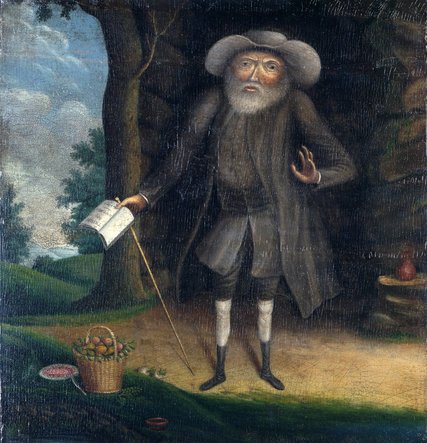
It was September 1738, and Benjamin Lay had walked 20 miles, subsisting on “acorns and peaches,” to reach the Quakers’ Philadelphia Yearly Meeting. Beneath his overcoat he wore a
military uniform and a sword — both anathema to Quaker teachings. He also carried a hollowed-out book with a secret compartment, into which he had tucked a tied-off animal bladder
filled with bright red pokeberry juice.
When it was Lay’s turn to speak, he rose to address the Quakers, many of whom had grown rich and bought African slaves. He was a dwarf, barely four feet tall, but from his small body
came a thunderous voice. God, he intoned, respects all people equally, be they rich or poor, man or woman, white or black.
Throwing his overcoat aside, he spoke his prophecy: “Thus shall God shed the blood of those persons who enslave their fellow creatures.” He raised the book above his head and plunged
the sword through it. As the “blood” gushed down his arm, several members of the congregation swooned. He then splattered it on the heads and bodies of the slave keepers. His message
was clear: Anyone who failed to heed his call must expect death — of body and soul.
Lay did not resist when his fellow Quakers threw him out of the building. He knew he would be disowned by his beloved community for his performance, but he had made his point. As long
as Quakers owned slaves, he would use his body and his words to disrupt their hypocritical routines…
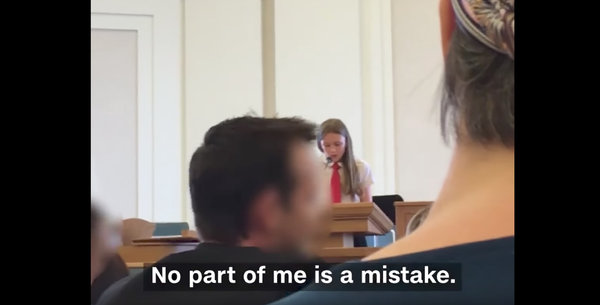
This week, a video of a 12-year-old girl coming out as gay to her Mormon congregation in Eagle Mountain, Utah, went viral — and it’s easy to understand why. Savannah is adorable. She wears a red tie, which is already a
statement, since wearing pants to church as a woman can be controversial. She stands in front of a room of adults delivering her testimony about how her Heavenly Parents “did not mess up when they gave me freckles. Or when they made me
gay. God loves me just this way because I believe that he loves all of his creations.”
It was the faith of two US presidents and several prominent UK industrialists, yet the origins of the Quaker religion are little known today by people living in the English town where
it began. However, a new heritage trail targeting the American tourist market is aiming to change that.
In 1647, George Fox, a cobbler, was walking past a church in the East Midlands when he received what he described as a message from God.
The son of a Leicestershire church warden, he had spent years wandering around an England torn apart by civil war and increasingly disaffected with the establishment church.
The vision of Christianity he received outside the church in Mansfield, Nottinghamshire, was deeply radical – God was within everyone and there was no need for priests.
Within a few years, he was preaching to large crowds – and provoking the persecution of the authorities who felt threatened by his anti-priesthood agenda.
“He was fed up with preachers and professionals setting standards, leaving out the poorest people,” said Ralph Holt, a historian.
“He couldn’t see how someone could go to college and get a certificate and come back somewhere between this land and God.”
There’s a word that seems to be being gradually redefined in our collective vocabulary, I was considering recently. That word is “nontheist”. It’s a relatively new word as it is, but in
its earliest uses it seems to have been an umbrella term covering a variety of different (and broadly-compatible) theological outlooks.
Here are some of them, in alphabetical order:
agnostic
“It is not possible to know whether God exists.”
Agnostics believe that it is not possible to know whether or not there are any gods. They vary in the strength of their definition of the word “know”, as well as their
definition of the word “god”. Like most of these terms, they’re not mutually-exclusive: there exist agnostic atheists, for example (and, of course, there exist agnostic theists,
gnostic atheists, and gnostic theists).
antitheist
“Believing in gods is a bad thing.”
Antitheists are opposed to the belief in gods in general, or to the practice of religion. Often, they will believe that the world would be better in the absence of religious
faith, to some degree or another. In rarer contexts, the word can also mean an opposition to a specific deity (e.g. “I believe that in God, but I hate Him.”).
apatheist
“If the existence of God could be proven/disproven to me, it would not affect my behaviour.”
An apatheist belives that the existence or non-existence of gods is irrelevant. It is perfectly possible to define oneself as a theist, an atheist, or neither, and still be
apathetic about the subject. Most of them are atheists, but not all: there are theists – even theists with a belief in a personal god – who claim that their behaviour would be
no different even if you could (hypothetically) disprove the existence of that god, to them.
atheist
“There are no gods.”
As traditionally-defined, atheists deny the existence of either a specific deity, or – more-commonly – any deities at all. Within the last few hundred years, it has also come to
mean somebody who rejects that there is any valid evidence for the existence of a god, a subtle difference which tends to separate absolutists from relativists. If you can’t see
the difference between this and agnosticism, this blog post might help. Note also that atheism does not always imply materialism or naturalism: there exist atheists for
example who believe in ghosts or in the idea of an immortal soul.
deist
“God does not interfere with the Universe.”
Deism is characterised by a belief in a ‘creator’ or ‘architect’ deity which put the universe into motion, but which does has not had any direct impact on it thereafter. Deists
may or may not believe that this creator has an interest in humanity (or life at all), and may or may not feel that worship is relevant. Note that deism is nontheistic (and, by
some definitions, atheistic) in that it denies the existence of a specific God – a personal God with a concern for human affairs – and so appears on this list even though it’s
incompatible with many people’s idea of nontheism.
freethinker
“Science and reason are a stronger basis for decision-making than tradition and authority.”
To be precise, freethought is a philosophical rather than a theological position, but its roots lie in the religious: in the West, the term appeared in the 17th century to
describe those who rejected a literalist interpretation of the Bible. It historically had a broad crossover with early pantheism, as science began to find answers (especially in
the fields of astronomy and biology) which contradicted the religious orthodoxy. Nowadays, most definitions are functionally synonymous with naturalism and/or rationalism.
humanist
“Human development is furthered by reason and ethics, and rejection of superstition.”
In the secular sense (as opposed to the word’s many other meanings in other fields), humanism posits that ethical and moral behaviour, for the benefit of individual humans and
for society in general, can be attained without religion or a deity. It requires that individuals assess viewpoints for themselves and not simply accept them on faith. Note that
like much of this list, secular humanism is not incompatible with other viewpoints – even theism: it’s certainly possible to believe in a god but still to feel that society is
always best-served by a human-centric (rather than a faith-based) model.
igtheist
“There exists no definition of God for which one can make a claim of theism or atheism.”
One of my favourite nontheistic terms, igtheism (also called ignosticism) holds that words like “god” are not cognitively meaningful and can not be argued for or against. The
igtheist holds that the question of whether or not any deities exist is meaningless not because any such deities are uninterested in human affairs (like the deist) or because
such a revelation would have no impact upon their life (like the apatheist) but because the terms themselves have no value. The word “god” is either ill-defined, undefinable, or
represents an idea that is unfalsifiable.
materialist
“The only reality is matter and energy. All else is an illusion caused by these.”
The materialist perspective holds that the physical universe is as it appears to be: an effectively-infinite quantity of matter and energy, traveling through time. It’s
incompatible with many forms of theism and spiritual beliefs, but not necessarily with some deistic and pantheistic outlooks: in many ways, it’s more of a philosophical stance
than a nontheistic position. It grew out of the philosophy of physicalism, and sharply contrasts the idealist or solipsist thinking.
naturalist
“Everything can be potentially explained in terms of naturally-occurring phenomena.”
A closely-related position to that of materialism is that of naturalism. The naturalist, like the materialist, claims that there can be, by definition, no supernatural
occurrences in our natural universe, and as such is similarly incompatible with many forms of theism. Its difference, depending on who you ask, tends to be described as being
that naturalism does not seek to assume that there is not possibly more to the universe than we could even theoretically be capable of observing, but that does not make such
things “unnatural”, much less “divine”. However, in practice, the terms naturalism and materialism are (in the area of nontheism) used interchangeably. The two are also similar
to some definitions of the related term, “rationalism”.
pantheist
“The Universe and God are one and the same.”
The pantheist believes that it is impossible to distinguish between God and the University itself. This belief is nontheistic because it typically denies the possibility of a
personal deity. There’s an interesting crossover between deists and pantheists: a subset of nontheists, sometimes calling themselves “pandeists”, who believe that the Universe
and the divine are one and the same, having come into existence of its own accord and running according to laws of its own design. A related but even-less-common concept is
panentheism, the belief that the Universe is only a part of an even-greater god.
secularist
“Human activities, and especially corporate activities, should be separated from religious teaching.”
The secularist viewpoint is that religion and spiritual thought, while not necessarily harmful (depending on the secularist), is not to be used as the basis for imposing upon
humans the a particular way of life. Secularism, therefore, tends to claim that religion should be separated from politics, education, and justice. The reasons for secularism
are diverse: some secularists are antitheistic and would prefer that religion was unacceptable in general; others take a libertarian approach, and feel that it is unfair for one
person to impose their beliefs upon another; still others simply feel that religion is something to be “kept in the home” and not to be involved in public life.
skeptic
“Religious authority does not intrinsically imply correctness.”
Religious skeptics, as implied by their name, doubt the legitimacy of religious teaching as a mechanism to determine the truth. It’s a somewhat old-fashioned term, dating back
to an era in which religious skepticism – questioning the authority of priests, for example – was in itself heretical: something which in the West is far rarer than it once was.
transtheist
“I neither accept nor reject the notion of a deity, but find a greater truth beyond both possibilities.”
The notion of transtheism, a form of post-theism, is that there exists a religious philosophy that exists both outside and beyond that of both theism and atheism.
Differentiating between this and deism, or apatheism, is not always easy, but it’s a similar concept to Jain “transcendence”: the idea that there may or may not exist things
which may be called “godlike”, but the ultimate state of being goes beyond this. It can be nontheistic, because it rejects the idea that a god plays a part in human lives, but
is not necessarily atheistic.
However, I’ve observed that the word “nontheist” seems to be finding a new definition, quite apart from the umbrella description above.
In recent years, a number of books have been published on the subject of atheism, some of which – and especially The God Delusion – carry a significant antitheistic undertone. This has helped to inspire the idea that atheism and
antitheism are the same thing (which for many atheists, and a tiny minority of antitheists, simply isn’t true), and has lead some people who might otherwise have described themselves as
one or several of the terms above to instead use the word “nontheist” as a category of its own.
This “new nontheist” definition is still very much in its infancy, but I’ve heard it described as “areligious, but spiritual”, or “atheistic, but not antitheistic”.
Personally, I don’t like this kind of redefinition. It’s already hard enough to have a reasonable theological debate – having to stop and define your terms every step of the way is
quite tiresome! – without people whipping your language out from underneath you right when you were standing on it. I can see how those people who are, for example, “atheistic, but not
antitheistic” might want to distance themselves from the (alliterative) antitheistic atheist authors, but can’t they pick a different word?
After all: there’s plenty of terms going spare, above, to define any combination of nontheistic belief, and enough redundancy that you can form a pile of words higher than any Tower of
Babel. Then… perhaps… we can talk about religion without stopping to fight over which dictionary is the true word.
This blog post is about Marmite. I apologise if it makes you hungry, nauseous, or confused.
Your mate. Marmite.
My partner enjoys Marmite. This isn’t a surprise: I’ve known it for years. Some weekend mornings I’ve seen her enthusiastically scoff down some Marmite on toast, and I’ve known times
that she’s been feeling run-down and hungry and the prospect of a bit of Marmite is exactly what she needs to get her motor running again. She doesn’t eat it all the time, but she
likes to keep a jar around in anticipation: Marmite lasts pretty much forever, so there’s no hurry.
It’s only since living with her, though, that I’ve seen so much of the strange sticky substance as I have. That’s not her doing, I’ll stress: she’s always respectful of the fact that I
seem to just be one of those people who’s just never going to be a Marmite-eater, and she doesn’t surprise me with Marmite-infused foodstuffs. In exchange, I try not to complain
whenever I can smell that the jar is open.
Her husband enjoys Marmite too. Sometimes she makes Marmite whirls, pastry spirals with a sharp taste of Marmite, and I think she does so mostly because she knows that he enjoys them so
much. I honestly don’t know how often he eats the stuff other than when she serves it: occasionally, I guess.
Marmite whirls. You love them, or you hate them, or you go round and round and round them like an escaped rollercoaster.
I’ve only recently kept Marmite in my cupboard: it’s a new addition to my food supply. Are my partner and husband responsible for this? No… well, only insofar as that they once reminded
me that they keep Marmite in the house: “We keep our Marmite in this cupboard,” they said, and that was that. (sometimes they disagree on which shelf the Marmite belongs on,
but more often than not they’re in agreement)
But now there’s Marmite in my cupboard. I’m not sure why I keep it there. I still don’t really like Marmite, although I think that with experience I’ve learned to appreciate
what others see in its flavour, even if it doesn’t sit comfortably in me.
I look at the jar of Marmite in my cupboard. “Why are you there?” I ask it, “What am I supposed to do with you?” It doesn’t answer. It is, of course, only Marmite. I realise that I’m
standing alone in the kitchen, talking to my shelf, and I feel a little stupid. But it’s a puzzle that I can’t solve: how did the Marmite even get into my cupboard? I certainly didn’t
buy it. Did it… put itself there?
Time for some buttered toast.
This blog post is not about Marmite. My apology still stands.
Last week, I was invited to a barbeque with Oxford’s Young Friends. Despite being neither a Friend
(in their “capital-F” meaning of the word: a Quaker) nor young (at least; not so young as I was, whatever that means), I went along and showed off my barbecue skills. It also gave me an
excuse to make use of my Firestick – a contemporary tinderbox – to generally feel butch
and manly, perhaps in an effort to compensate for the other week.
Anyway: this is how I discovered halloumi and mushroom skewers. Which may now have become my favourite barbeque foodstuff. Wow. Maybe it’s
just the lack of mushrooms in my diet (we operate a cooking rota on Earth, but
Paul doesn’t like mushrooms so I usually only get them when he or I happen to be eating elsewhere), but these things are
just about the most delicious thing that you can pull off hot coals.
Aside from meat, of course.
Update: we just had some at the Three Rings Code Week, and they were almost as delicious once again,
despite being hampered by a biting wind, frozen mushrooms, and a dodgy barbeque.