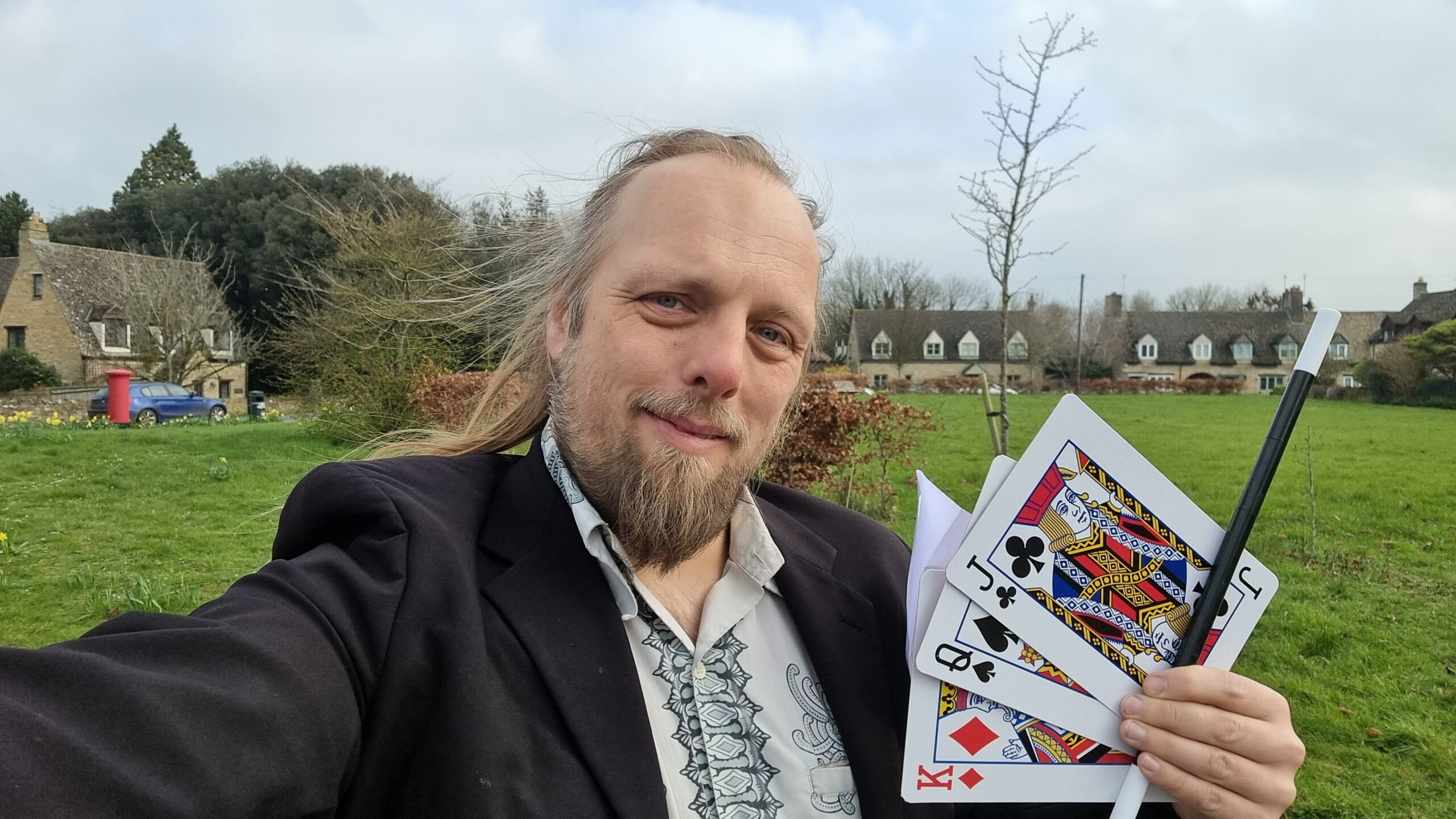
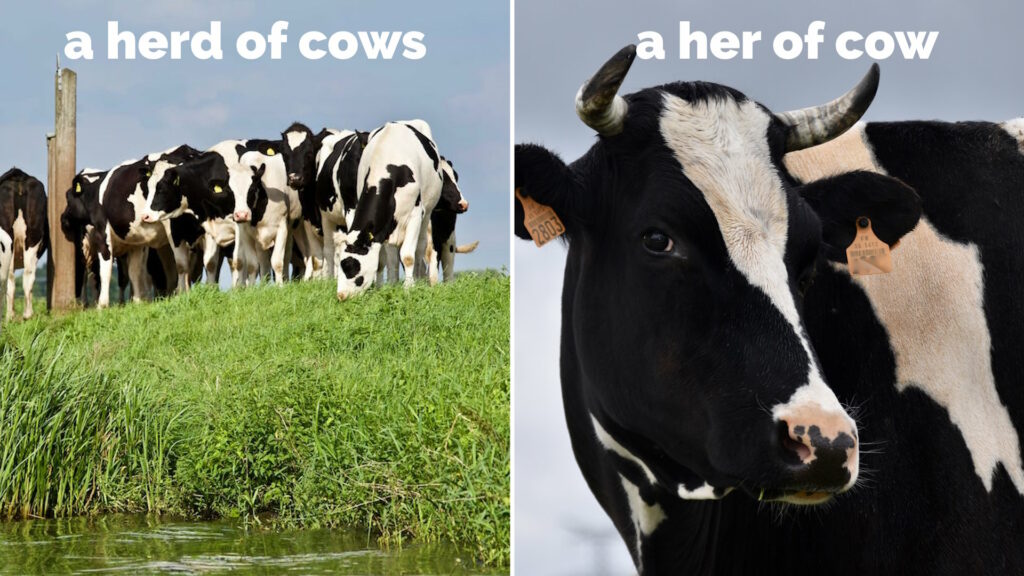
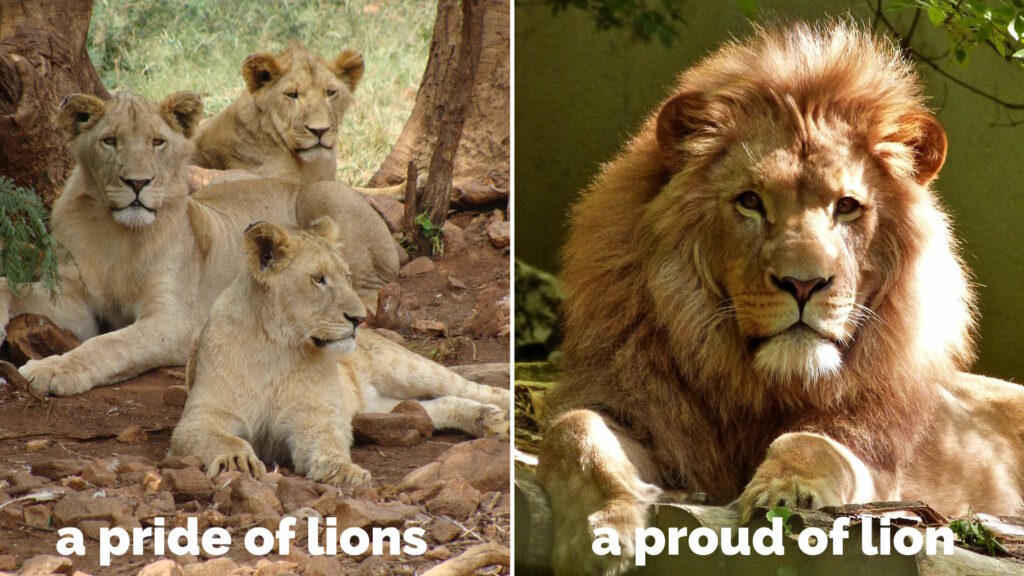
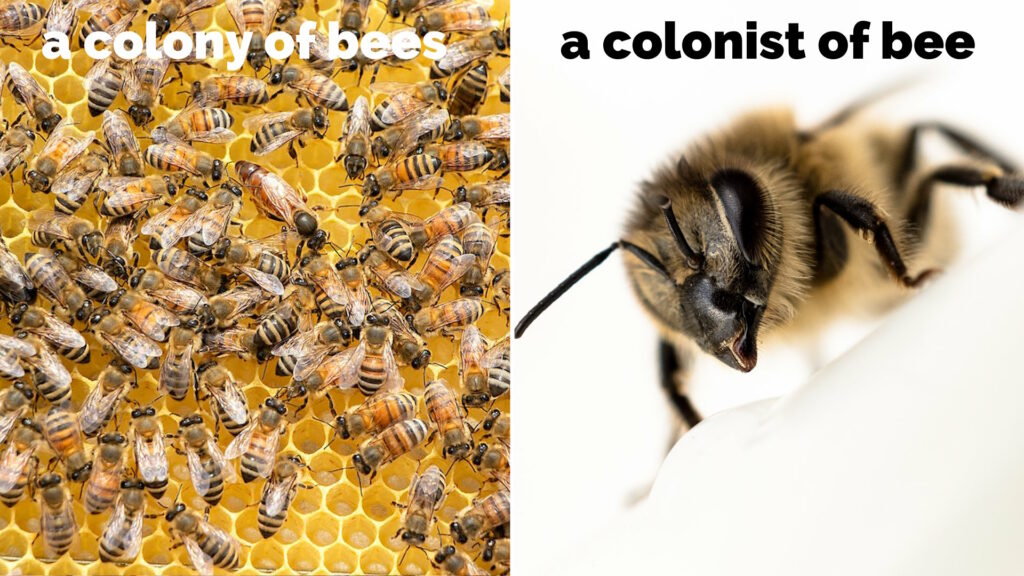
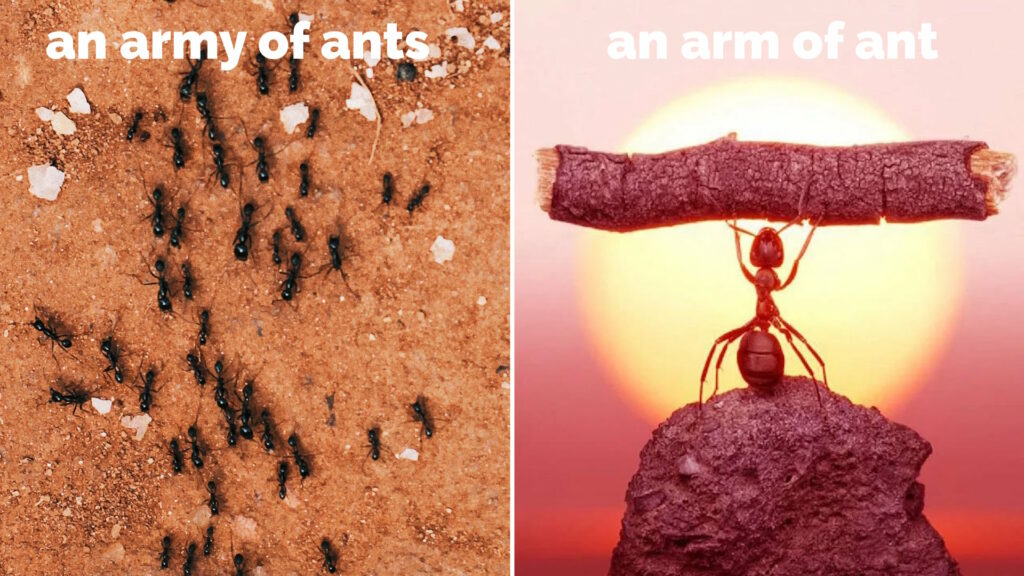
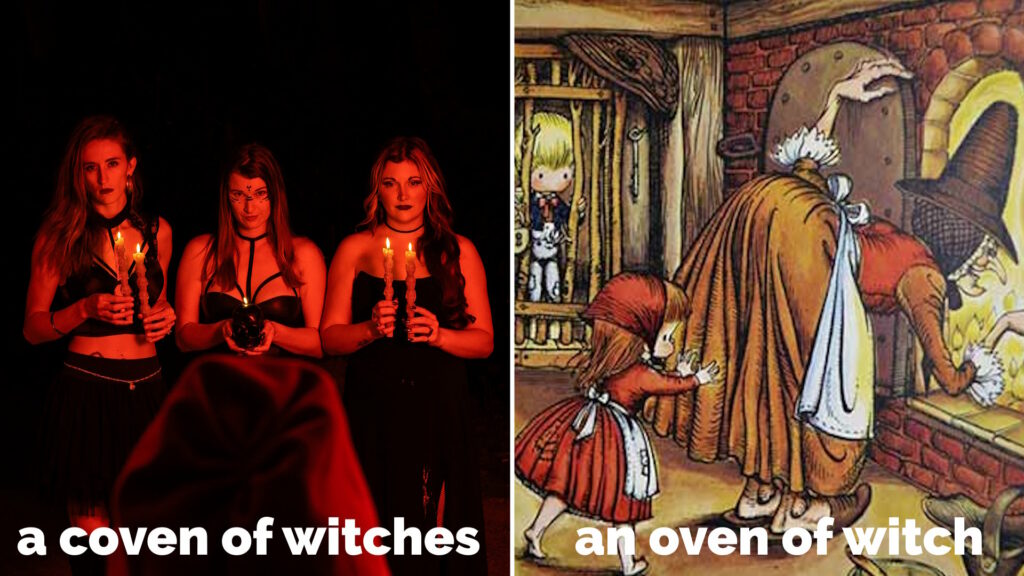
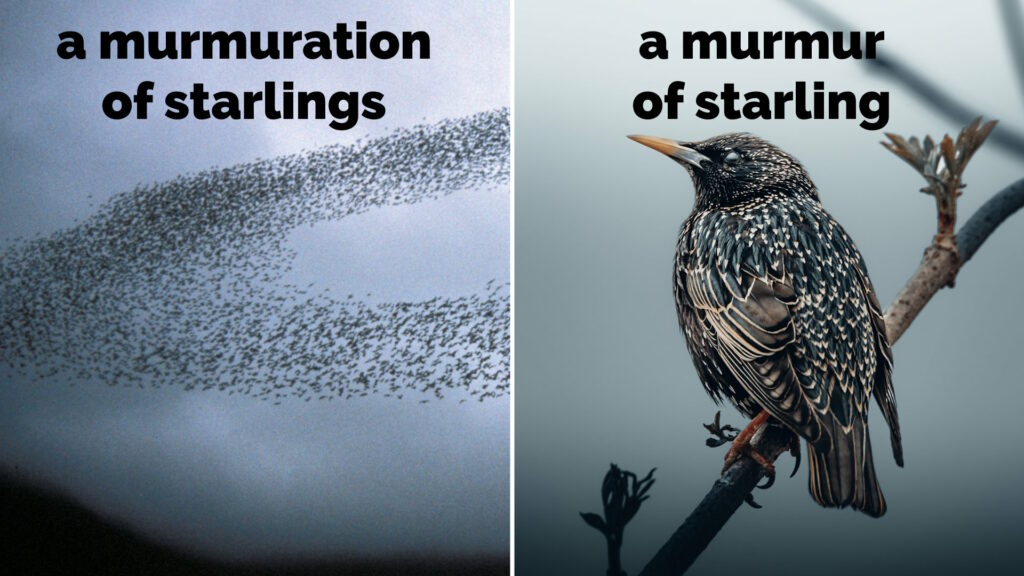
For World Book Day (which here in the UK is marked a month earlier than the rest of the world) the kids’ school invited people to come
“dressed as a word”.
As usual, the kids and teachers participated along with only around two other adults. But of course I was one of them.
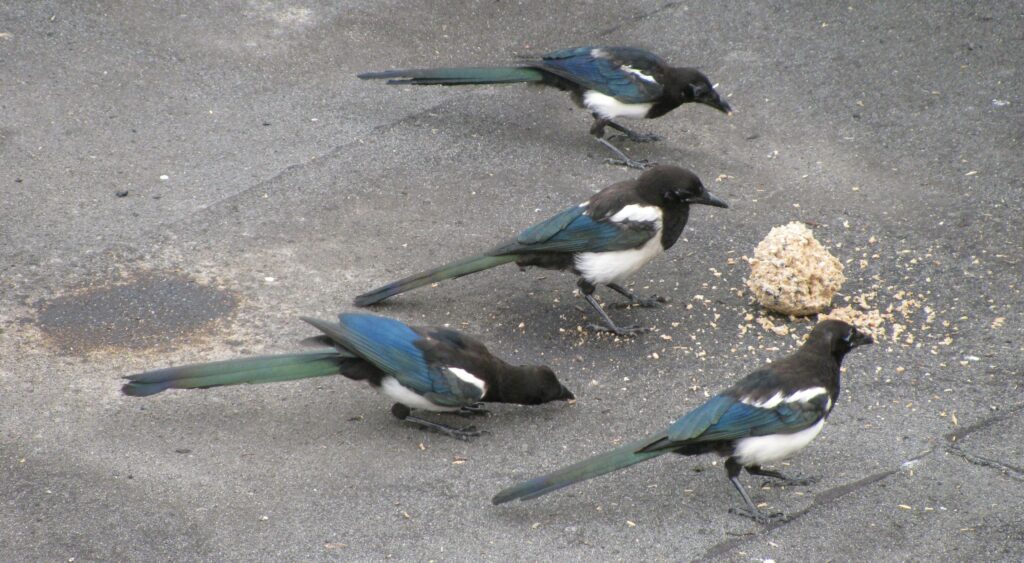
One for joy, two for joy, three for joy, four for joy… basically any natural number of magpies brings me joy.
They’re smart (among the smartest corvids, who are already among the smartest birds).
They’re curious. They’re sociable. And they’re ever so pretty.
They’re common enough that you can see them pretty-much anywhere.
They steal things. They solve puzzles. They’re just awesome.
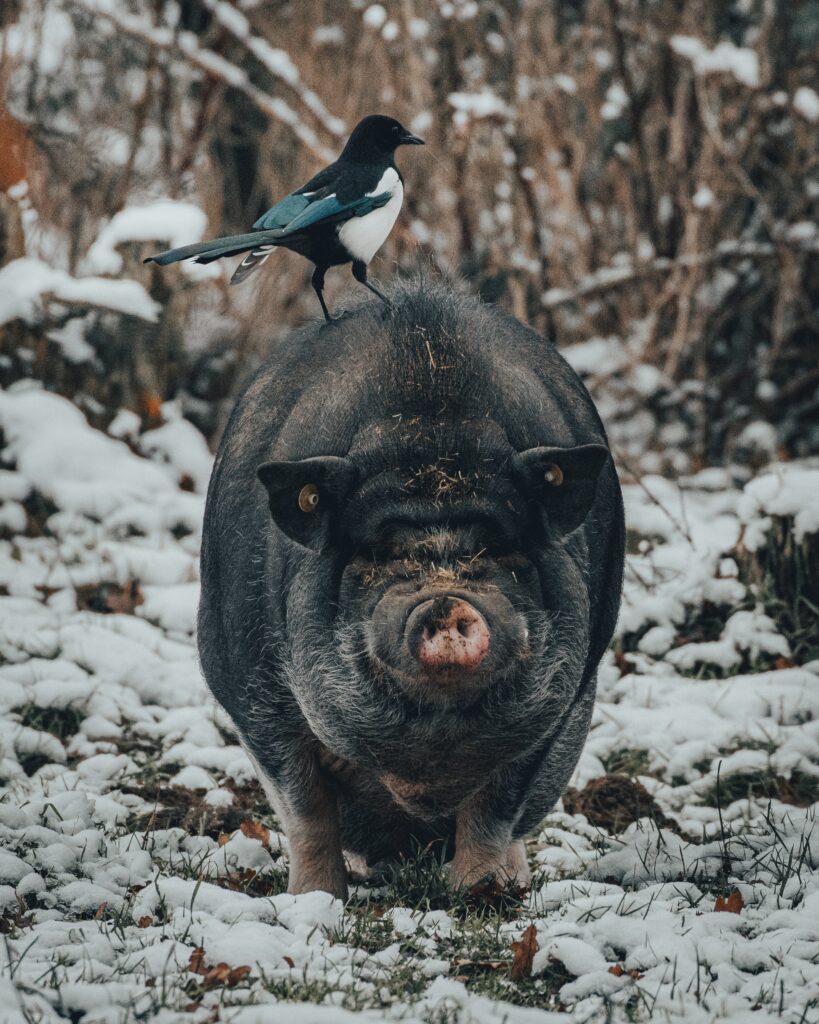
This is photo of a magpie riding a pig through the snow, which is objectively fantastic. No further explanation is required, nor given.
Also, did you know where their name comes from? It’s really cool:
In Medieval Latin, they’re called pica. It probably comes from Greek kitta, meaning “false appetite” and possibly related to the birds’ propensity for theft,
and/or from a presumed PIE1 root meaning “pointed” and referring to its beak shape.
In Old French, this became pie. They’re still called la pie in French today. Old English took this and also used pie.
By the 17th century, there came a fashion in English slang to give birds common names.
Sometimes the common name died out, such as with Old English wrenna which became wren and was extended to Jenny wren, which you’ll still hear nowadays
but mostly people just say wren.
Sometimes the original name disappeared, like with Old English ruddock2 which became
redbreast and was extended to Robin redbreast from which we get the modern name robin (although again, you’ll still sometimes hear robin
reabreast).
Magpie, though, retains both parts!3Mag in this case is short for
Margaret, a name historically associated with idle chatter4.
So we get pica > pie > Maggie pie > Mag pie > magpie! Amazing!
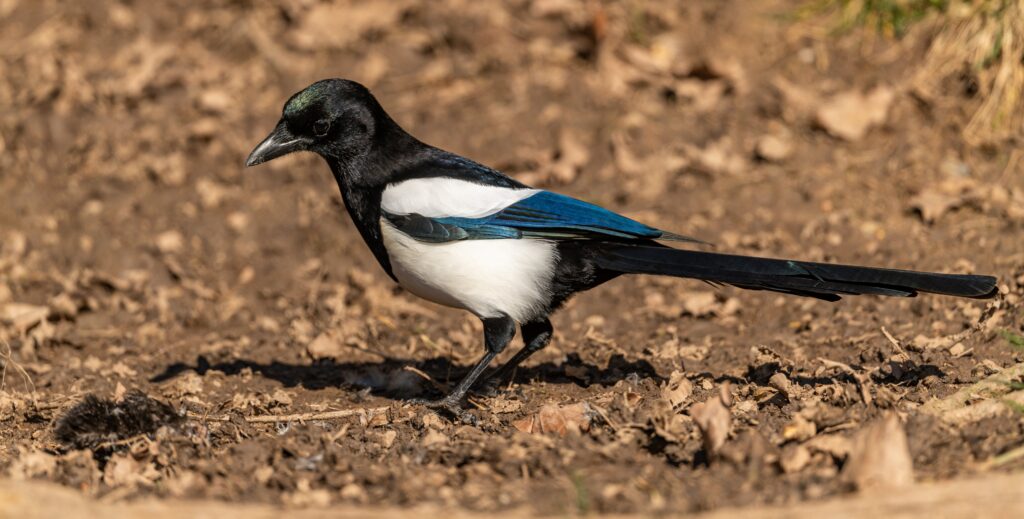
This magpie’s looking pretty chill. Also pretty. Also chill.
I probably have a soft spot for animals with distinct black-and-white colouration – other favourite animals might include the plains zebra, European badger, black-and-white ruffed
lemur, Malayan tapir, Holstein cattle, Atlantic puffin… – but the magpie’s the best of them. It hits the sweet spot in all those characteristics listed above, and it’s just a wonderful
year-around presence in my part of the world.
Footnotes
1 It’s somewhat confusing writing about the PIE roots of the word pie…
2Ruddock shares a root with “ruddy”, which is frankly a better description of
the colour of a robin’s breast than “red”.
3 Another example of a bird which gained a common name and retained both that and its
previous name is the jackdaw.
4 Reflective, perhaps, of the long bursts of “kcha-kcha-kcha-kcha-kcha-” chattering sounds
magpies make to assert themselves. The RSPB
have a great recording if you don’t know what I’m talking about – you’ll recognise the sound when you hear it! – but they also make a load of other vocalisations in the wild and can even learn to imitate human speech!
The other night, Ruth and I were talking about collective nouns (y’know, like a herd of cows or a flock of sheep) and came
up with the somewhat batty idea of solitary nouns. Like collective nouns, but for a singular subject (one cow, sheep, or whatever).
Then, we tried to derive what the words could be. Some of the results write themselves.1
Mooving right on…
I’d be lion if I said I wasn’t proud of this one.
I’m pollen out all the collective nouns now!
Some of them involve removing one or more letters from the collective noun to invent a shorter word to be the solitary noun.
They stay healthy by working out and getting vaccinated, both of which give them tough anty bodies.
The sound of an oven is a cackling: “When shall I one meet again?”
Eventually it grows up into a star, which are a lot louder.2For others, we really had to stretch the concept by mutating words in ways that “felt right”, using phoenetic spellings, or even inventing collective nouns so that we
could singularise them:
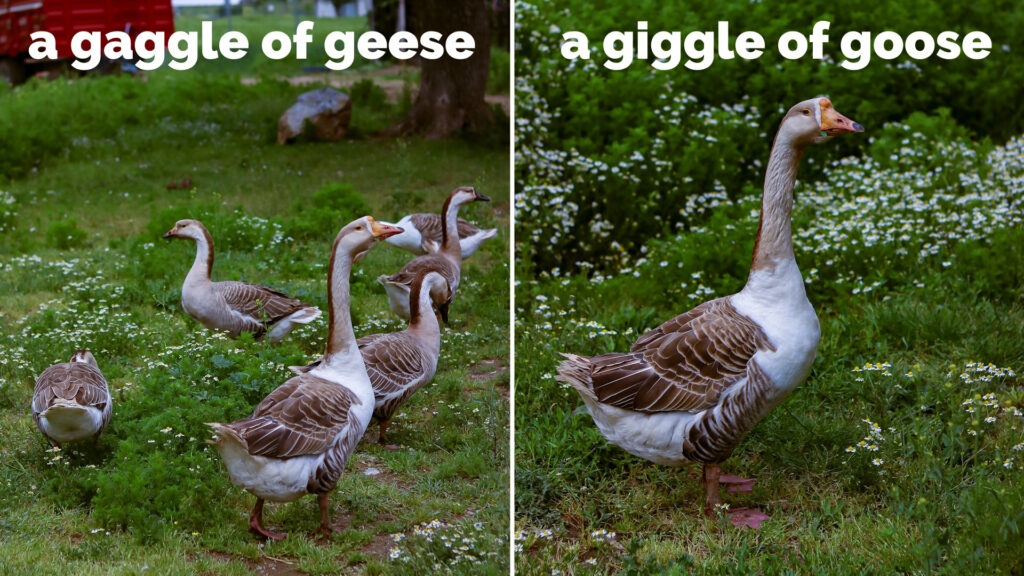
For more goose-related wordplay, take a gander at this blog post from a few years back.
Getting smashed doesn’t have to end with bumps and boozers.3
Blast but not least.
Did I miss any obvious ones?
Footnotes
1 Also consider “parliament of owls” ➔ “politician of owl”, “troop of monkeys” ➔ “soldier
of monkey”, “band of gorillas” ➔ “musician of gorilla”. Hey… is that where that band‘s name come from?
2 Is “cluster of stars” ➔ “luster of star” anything?
3 Ruth enjoyed the singularised “a low of old bollock”, too.
A few months ago, people were posting a lot about the Netherlands on Chinese social media platform Weibo. “Wake up, sleeping people of the Netherlands!” said one post. Others lamented
that the people of Amsterdam wanted their tulips back.
These Chinese social media users aren’t expressing a nascent interest in all things Dutch. They’re talking about recent protests over frozen bank deposits in the province of Henan. Ordinarily, discussions about a
controversial topic like this would be censored on Chinese social media, and posts containing the word “Henan” could be blocked or deleted. But “Henan” (河南) sounds a lot like “Helan”
(荷兰), the Mandarin word for the Netherlands. By swapping the names around, people were able to get past the censors and keep the conversation going.
…
I love this article. The use of homonyms and puns to work around online censorship by Chinese citizens is as innovative and heartwarming as its necessity is horrifying and tragic. If
you’re wondering exactly how similar 河南 (“Henan”, the name of the Chinese province in which authorities
abused social distancing laws and used violence to prevent rural bank customers from withdrawing their own money) and 荷兰 (“Helan”, The Netherlands) sound, have a listen for
yourself:
Unless you speak Mandarin already, you’ll might struggle to even pinpoint which is which in that recording.
This clever and imaginative use of language to try to sidestep surviellance feels like a modern adaptation of cryptolects like Polari or rhyming slang as used in the UK for the same
purpose. But writing in Han characters online seems to provide an amazingly diverse way to encode meaning that an in-the-know human can parse, but an automated machine or an uninformed
human censor can not. The story about the use of the word for “paratrooper” on Chinese social media, touched upon in the article linked above and expanded elsewhere, is particularly enjoyable.
Anyway, after you’ve read the article and you’re ready for a whole new rabbit whole to explore, I’d like to kickstart you by introducing you to Totoiana, a Pig Latin-like (second-syllable onwards, then first syllable) dialect
spoken with fluency exclusively in a single Romanian village, and nobody knows why.
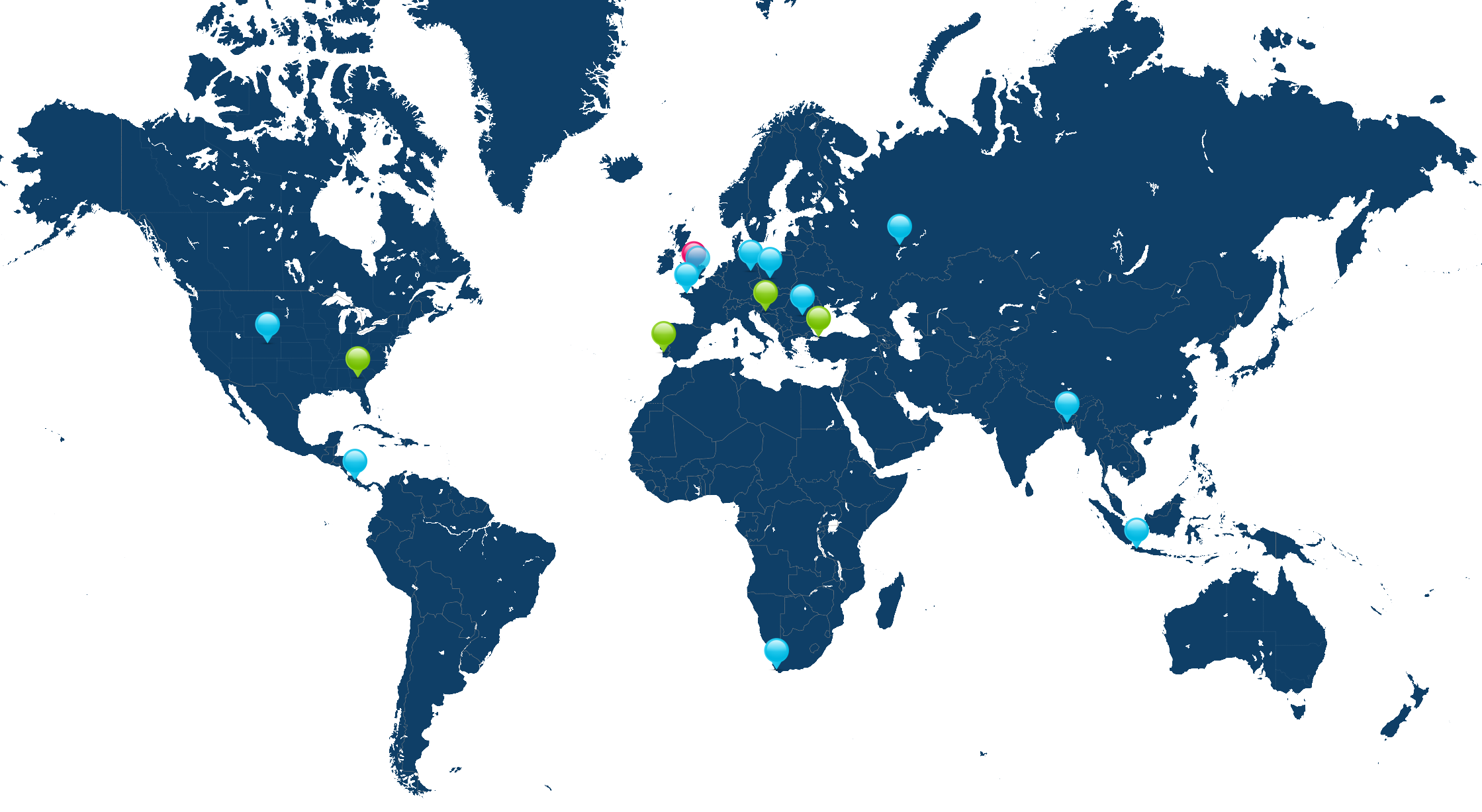
Take a look at the map below. I’m the pink pin here in Oxfordshire. The green pins are my immediate team – the people I work with on a
day-to-day basis – and the blue pins are people outside of my immediate team but in its parent team (Automattic’s org chart is a bit like a fractal).
I’m the pink pin; my immediate team are the green pins. People elsewhere in our parent team are the blue pins. Some pins represent multiple people.
Thinking about timezones, there are two big benefits to being where I am:
I’m in the median timezone, which makes times that are suitable-for-everybody pretty convenient for me (I have a lot of lunchtime/early-afternoon meetings where I get to
watch the sun rise and set, simultaneously, through my teammates’ windows).
I’m West of the mean timezone, which means that most of my immediate coworkers start their day before me so I’m unlikely to start my day blocked by anything I’m waiting on.
(Of course, this privilege is in itself a side-effect of living close to the meridian, whose arbitrary location owes a lot to British naval and political clout in the 19th century: had
France and Latin American countries gotten their way the prime median would have probably cut through the Atlantic or Pacific oceans.)
2. Language Privilege
English is Automattic’s first language (followed perhaps by PHP and Javascript!), not one of the 120 other languages spoken
by Automatticians. That’s somewhat a consequence of the first language of its founders and the language in which the keywords of most programming languages occur.
It’s also a side-effect of how widely English is spoken, which in comes from (a) British colonialism and (b) the USA using
Hollywood etc. to try to score a cultural victory.
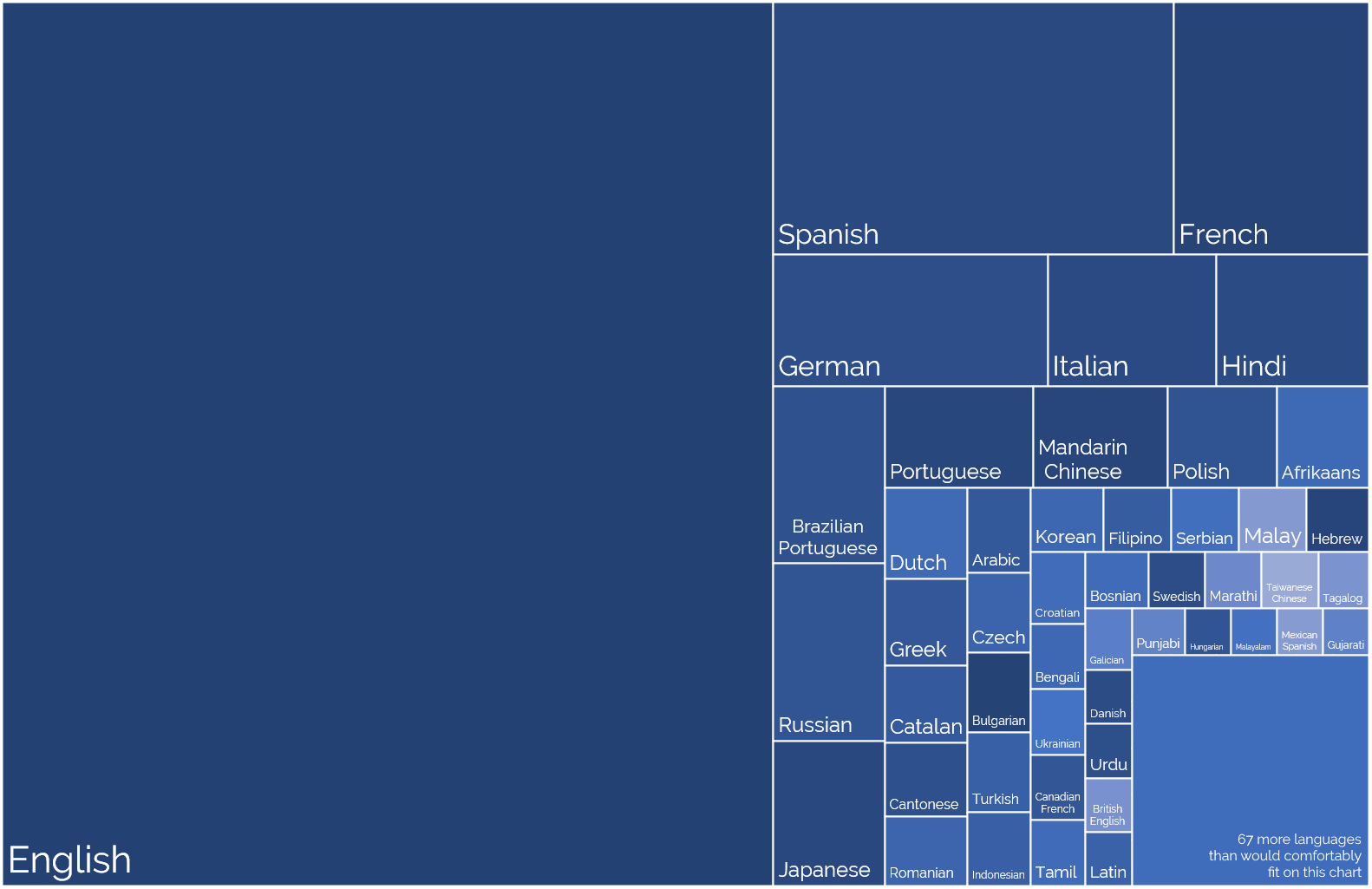
Languages self-reportedly spoken by Automatticians, sized proportional to the number of speakers. No interpretation/filtering has been done, so you’ll see multiple dialects of the
same root language.
I’ve long been a fan of the concept of an international axillary language but I appreciate that’s an idealistic dream whose war
has probably already been lost.
For now, then, I benefit from being able to think, speak, and write in my first language all day, every day, and not have the experience of e.g. my two Indonesian colleagues who
routinely speak English to one another rather than their shared tongue, just for the benefit of the rest of us in the room!
3. Passport Privilege
Despite the efforts of my government these last few years to isolate us from the world stage, a British passport holds an incredible amount of power, ranking fifth or sixth in the world depending on whose passport index you
follow. Compared to many of my colleagues, I can enjoy visa-free and/or low-effort travel to a wider diversity of destinations.
Normally I might show you a map here, but everything’s a bit screwed by COVID-19, which still bars me from travelling to many
places around the globe, but as restrictions start to lift my team have begun talking about our next in-person meetup, something we haven’t done since I first started when I met up with my colleagues in Cape Town and got
assaulted by a penguin.
But even looking back to that trip, I recall the difficulties faced by colleagues who e.g. had to travel to a different country in order tom find an embassy just to apply for the visa
they’d eventually need to travel to the meetup destination. If you’re not a holder of a privileged passport, international travel can be a lot harder, and I’ve definitely taken that for
granted in the past.
I’m going to try to be more conscious of these privileges in my industry.
Prior to 2018, Three Rings had a relatively simple approach to how it would use pronouns when referring to volunteers.
If the volunteer’s gender was specified as a “masculine” gender (which particular options are available depends on the volunteer’s organisation, but might include “male”, “man”, “cis
man”, and “trans man”), the system would use traditional masculine pronouns like “he”, “his”, “him” etc.
If the gender was specified as a “feminine” gender (e.g .”female”, “woman”, “cis women”, “trans woman”) the system would use traditional feminine pronouns like “she”, “hers”, “her” etc.
For any other answer, no specified answer, or an organisation that doesn’t track gender, we’d use singular “they” pronouns. Simple!
This selection was reflected
throughout the system. Three Rings might say:
They have done 7 shifts by themselves.
She verified her email address was hers.
Would you like to sign him up to this shift?
Unfortunately, this approach didn’t reflect the diversity of personal pronouns nor how they’re applied. It didn’t support volunteer whose gender and pronouns are not
conventionally-connected (“I am a woman and I use ‘them/they’ pronouns”), nor did it respect volunteers whose pronouns are not in one of these three sets (“I use ze/zir pronouns”)… a
position it took me an embarrassingly long time to fully comprehend.
So we took a new approach:
The New Way
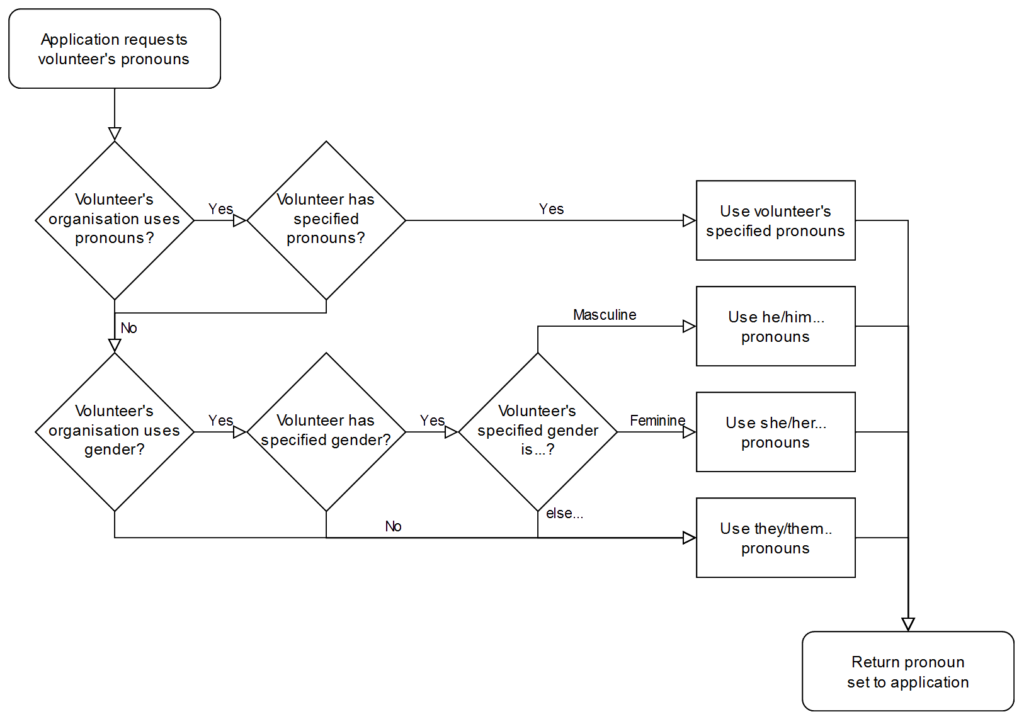
From 2018 we allowed organisations to add a “Pronouns” property, allowing volunteers to select from 13 different pronoun sets. If they did so, we’d use it; failing that we’d continue to
assume based on gender if it was available, or else use the singular “they”.
The process has some further complexities to cover the fact that we say “they are” but “he is“, but this broadly covers it.
Let’s take a quick linguistics break
Three Rings‘ pronoun field always shows five personal pronouns, separated by slashes, because you can’t necessarily derive one from another. That’s one for each of
five types:
the subject, used when the person you’re talking about is primary argument to a verb (“he called”),
object, for when the person you’re talking about is the secondary argument to a transitive verb (“he called her“),
dependent possessive, for talking about a noun that belongs to a person (“this is their shift”),
independent possessive, for talking about something that belongs to a person potentially would an explicit noun (“this is theirs“), and the
reflexive (and intensive), two types which are generally the same in English, used mostly in Three Rings when a person is both the subject
and indeirect of a verb (“she signed herself up to a shift”).
Let’s see what those look like – here are the 13 pronoun sets supported by Three Rings at the time of writing:
Subject
Object
Possessive
Reflexive/intensive
Dependent
Independent
he
him
his
himself
she
her
hers
herself
they
them
their
theirs
themselves
e
em
eir
eirs
emself
ey
eirself
hou
hee
hy
hine
hyself
hu
hum
hus
humself
ne
nem
nir
nirs
nemself
per
pers
perself
thon
thons
thonself
ve
ver
vis
verself
xe
xem
xyr
xyrs
xemself
ze
zir
zirs
zemself
That’s all data-driven rather than hard-coded, by the way, so adding additional pronoun sets is very easy for our developers. In fact, it’s even possible for us to apply an additional
“override” on an individual, case-by-case basis: all we need to do is specify the five requisite personal pronouns, separated by slashes, and Three Rings understands how to use
them.
Writing code that respects pronouns
Behind the scenes, the developers use a (binary-gendered, for simplicity) convenience function to produce output, and the system corrects for the pronouns appropriate to the volunteer
in question:
<%=@volunteer.his_her.capitalize %>
account has been created for
<%=@volunteer.him_her %>
so
<%=@volunteer.he_she %>
can now log in.
The code above will, dependent on the pronouns specified for the volunteer @volunteer, output something like:
His account has been created for him so he can now log in.
Her account has been created for her so she can now log in.
Their account has been created for them so they can now log in.
Eir account has been created for em so ey can now log in.
Etc.
We’ve got extended functions to automatically detect cases where the use of second person pronouns might be required (“Your account has been created for
you so you can now log in.”) as well as to help us handle the fact that we say “they are” but
“he/she/ey/ze/etc. is“.
It’s all pretty magical and “just works” from a developer’s perspective. I’m sure most of our volunteer developers don’t think about the impact of pronouns at all when they code; they
just get on with it.
Is that a complete solution?
Does this go far enough? Possibly not. This week, one of our customers contacted us to ask:
Is there any way to give the option to input your own pronouns? I ask as some people go by she/them or he/them and this option is not included…
You can probably see what’s happened here: some organisations have taken our pronouns property – which exists primarily to teach the system itself how to talk about volunteers – and are
using it to facilitate their volunteers telling one another what their pronouns are.
What’s the difference? Well:
When a human discloses that their pronouns are “she/they” to another human, they’re saying “You can refer to me using either traditional feminine pronouns (she/her/hers etc.)
or the epicene singular ‘they’ (they/their/theirs etc.)”.
But if you told Three Rings your pronouns were “she/her/their/theirs/themselves”, it would end up using a mixture of the two, even in the same sentence! Consider:
She has done 7 shifts by themselves.
She verified her email address was theirs.
That’s some pretty clunky English right there! Mixing pronoun sets for the same person within a sentence is especially ugly, but even mixing them within the same page can cause
confusion. We can’t trivially meet this customer’s request simply by adding new pronoun sets which mix things up a bit! We need to get smarter.
A Newer Way?
Ultimately, we’re probably going to need to differentiate between a more-rigid “what pronouns should Three Rings use when talking about you” and a more-flexible, perhaps
optional “what pronouns should other humans use for you”? Alternatively, maybe we could allow people to select multiple pronoun sets to display but Three Rings would
only use one of them (at least, one of them at a time!): “which of the following sets of pronouns do you use: select as many as apply”?
Even after this, there’ll always be more work to do.
For instance: I’ve met at least one person who uses no pronouns! By this, they actually
mean they use no third-person personal pronouns (if they actually used no pronouns they wouldn’t say “I”, “me”, “my”, “mine” or “myself” and wouldn’t
want others to say “you”, “your”, “yours” and “yourself” to them)! Semantics aside… for these people Three Ringsshould use the person’s name rather than a
pronoun.
Maybe we can get there one day.
Three Rings is already capable of supporting people who use no pronouns, but we don’t yet have a user interface to help them specify this! Maybe it’d look like this?
But so long as Three Rings continues to remain ahead of the curve in its respect for and understanding of pronoun use then I’ll be happy.
Our mission is to focus on volunteers and make volunteering easier. At the heart of that mission is treating volunteers with
respect. Making sure our system embraces the diversity of the 65,000+ volunteers who use it by using pronouns correctly might be a small part of that, but it’s a part of it, and I for
one am glad we make the effort.
My favourite thing about geese… is the etymologies of all the phrases relating to geese. There’s so many, and they’re all amazing. I started reading about one, then –
silly goose that I am – found another, and another, and another…
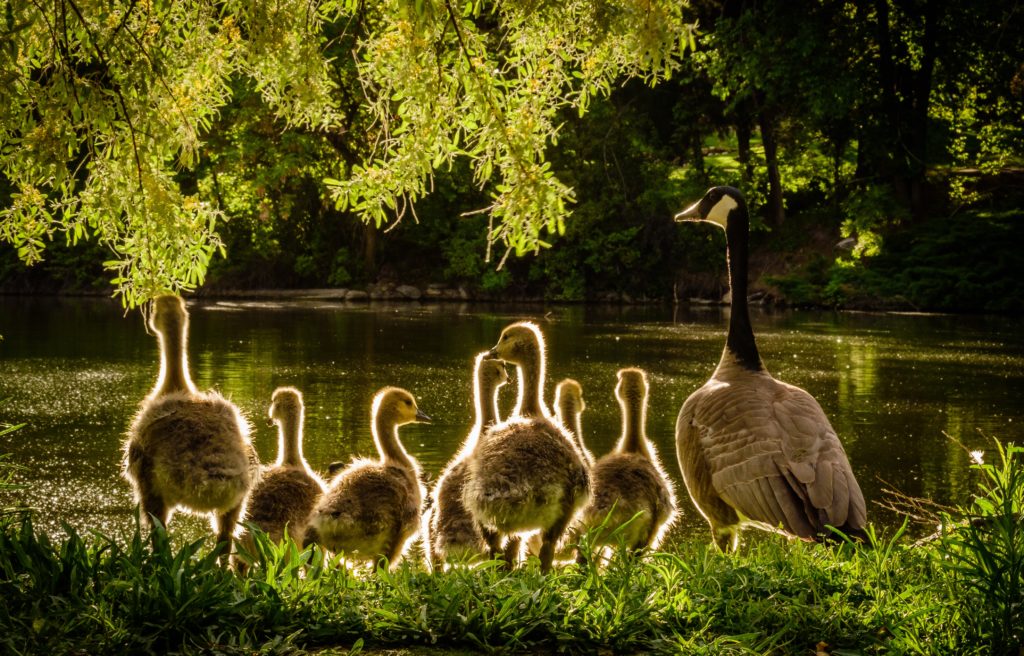
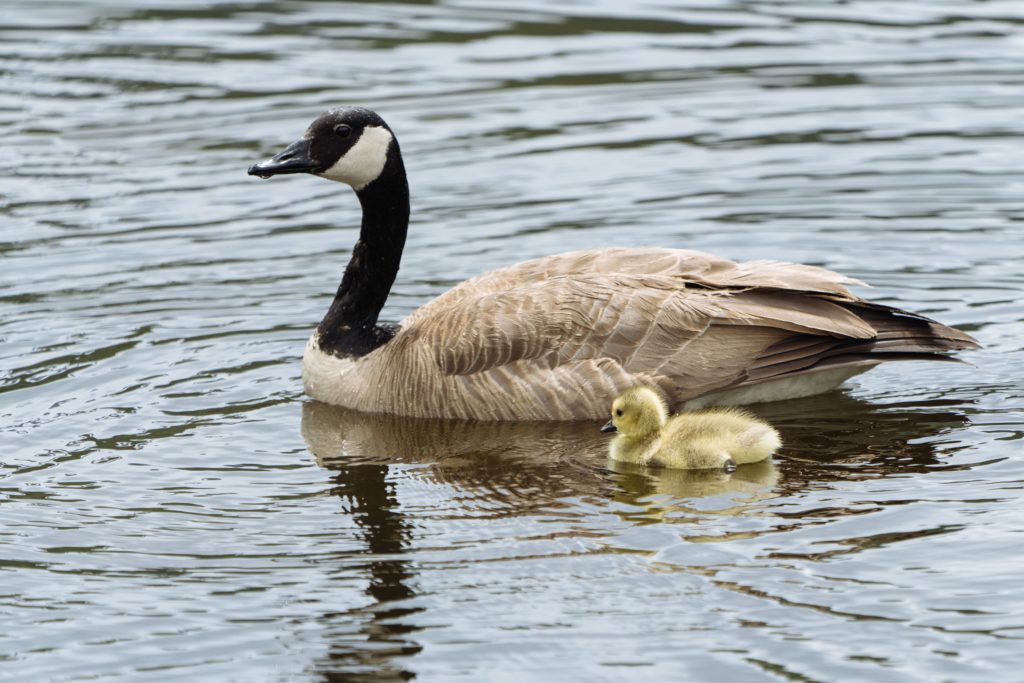
Have a gander at this photo.
For example:
Barnacle geese are so-called because medieval
Europeans believed that they grew out of a kind of barnacle called a goose barnacle, whose shell pattern… kinda, sorta
looks like barnacle goose feathers? Barnacle geese breed on remote Arctic islands and so people never saw their chicks, which – coupled with the fact that migration wasn’t understood
– lead to a crazy myth that lives on in the species name to this day. Incidentally, this strange belief led to these geese being classified as a fish for the purpose of
fasting during Lent, and so permitted. (This from the time period that brought us the Vegetable Lamb of Tartary, of course. I’ve written about both previously.)
Gooseberries may have a similar etymology. Folks have tried to connect it to old Dutch or Germanic words, but inconclusively: given that they appear at the opposite
end of the year to some of the migratory birds goose, the same kind of thinking that gave us “barnacle geese” could be seen as an explanation for gooseberries’ name, too. But really:
nobody has a clue about this one. Fun fact: the French name for the fruit is groseille à maquereau, literally “mackerel currant”!
A gaggle is the collective noun for geese, seemingly derived from the sound they make. It’s also been used to describe groups of humans, especially if they’re
gossiping (and disproportionately directed towards women). “Gaggle” is only correct when the geese are on the ground, by the way: the collective noun for a group of airborne geese is
skein or plump depending on whether they’re in a delta shape or not, respectively. What a fascinating and confusing language we have!
John Stephen Farmer helps us with a variety of goose-related sexual slang though, because, well, that was his jam. He observes that a goose’s neck was a penis and
gooseberries were testicles, goose-grease is vaginal juices. Related: did you ever hear the euphemism for where babies come from “under a
gooseberry bush“? It makes a lot more sense when you realise that gooseberry bush was slang for pubic hair.
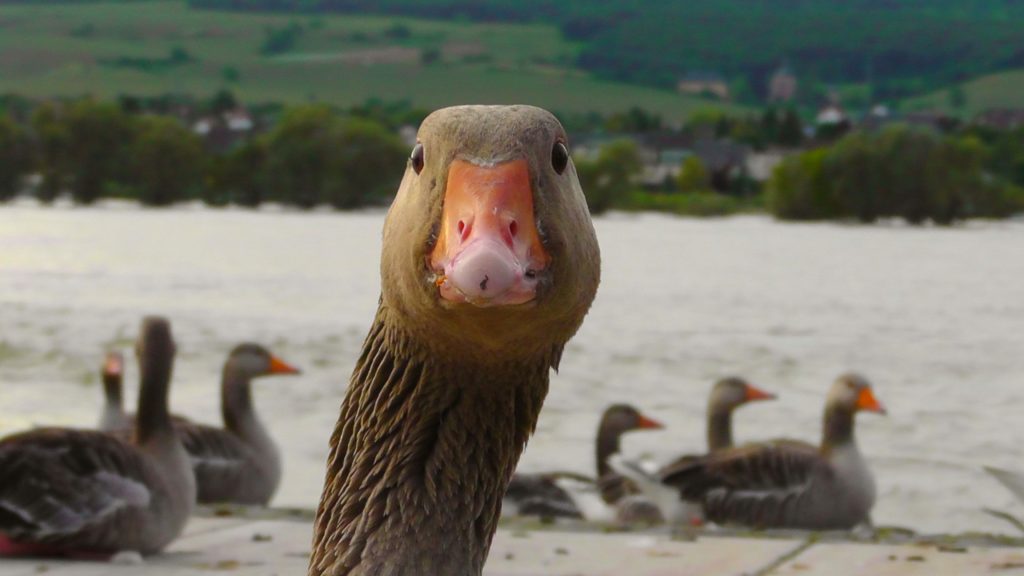
Hey there, you big honker.
An actor whose performance wasn’t up to scratch might describe the experience of being goosed; that is – hissed at by the crowd. Alternatively,
goosing can refer to a a pinch on the buttocks possibly in reference to geese pecking humans at about that same height.
If you have a gander at something you take a good look at
it. Some have claimed that this is rhyming slang – “have a look” coming from “gander and duck” – but I don’t buy it. Firstly, why wouldn’t it be “goose and duck” (or “gander and
drake“, which doesn’t rhyme with “look” at all). And fake, retroactively-described rhyming roots are very common: so-called mockney rhyming slang! I suspect
it’s inspired by the way a goose cranes its neck to peer at something that interests it! (“Crane” as a verb is of course also a bird-inspired word!)
Goosebumps might appear on your skin when you’re cold or scared, and the name alludes to the appearance of plucked poultry. Many languages use geese, but some use
chickens (e.g. French chair de poule, “chicken flesh”). Fun fact: Slavic languages often use anthills as the metaphor for goosebumps, such as Russian мурашки по коже (“anthill skin”). Recently, people talk of tapping into goosebumps if they’re using their fear as a motivator.
The childrens game of duck duck goose is played by declaring somebody to be a “goose” and then running away before they catch you. Chasing – or at risk of being
chased by! – geese is common in metaphors: if somebody wouldn’t say boo to a goosethey’re
timid. A wild goose chase (yet another of the many phrases for which we
can possibly thank Shakespeare, although he probably only popularised this one) begins without consideration of where it might end up.
If humans tell children they were found under a gooseberry bush, where do geese tell their chicks they came from?
If those children are like their parents, you might observe that a wild goose never laid a tame egg: that traits are inherited and predetermined.
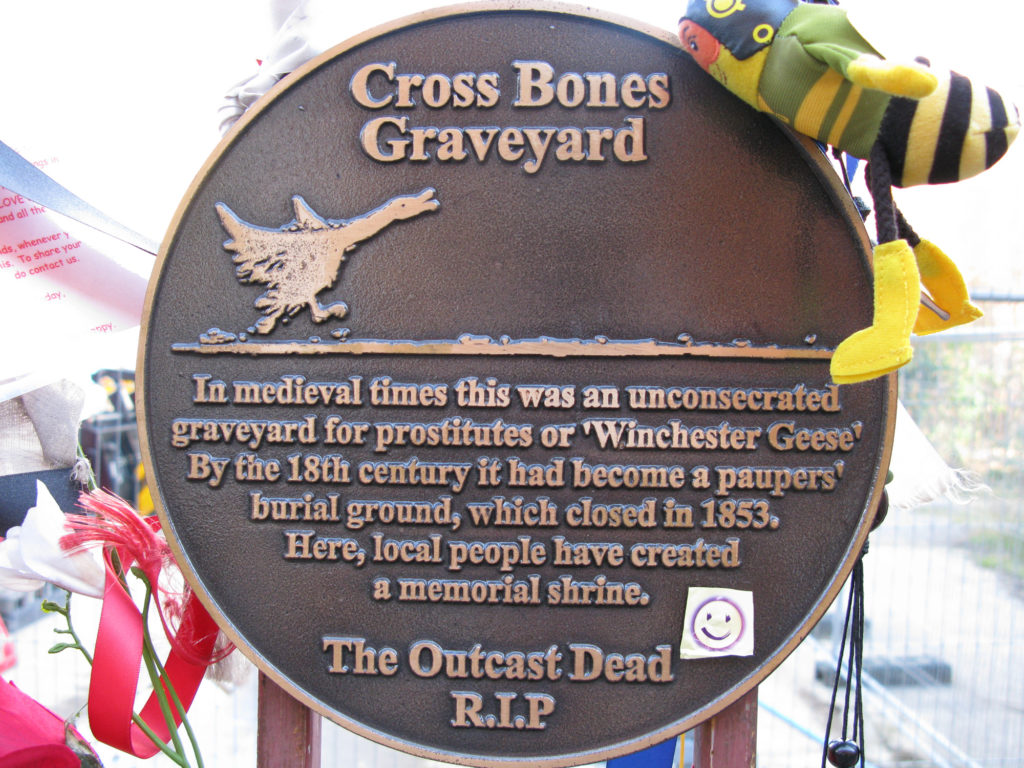
Until 1889, the area between Blackfriars and Tower Bridge in London – basically everything around Borough tube
station up to the river – was considered to be outside the jurisdiction of both London and Surrey, and fell under the authority of the Bishop of Winchester. For a few hundred years it
was the go-to place to find a prostitute South of the Thames, because the Bishop would license them to be able to trade there. These prostitutes were known as Winchester geese. As a result, to be
bitten by a Winchestergoose was to contract a venereal disease, and goosebumps became a slang term for the symptoms of some such
diseases.
Perennial achillea ptarmica is known, among other names, as goose tongue,
and I don’t know why. The shape of the plant isn’t particularly similar to that of a goose’s tongue, so I think it might instead relate to the effect of chewing the leaves, which
release a spicy oil that might make your tongue feel “pecked”? Goose tongue can also refer to plantago
maritima, whose dense rosettes do look a little like goose tongues, I guess. Honestly, I’ve no clue about this one.
If you’re sailing directly downwind, you might goose-wing your
sails, putting the mainsail away from the wind and the jib towards it, for balance and to easily maintain your direction. Of course, a modern triangular-sailed boat usually goes
faster broad reach (i.e. at an angle of about 45º to the wind) by enough that it’s faster to zig-zag downwind rather than go directly downwind, but I can see how one might sometimes
want to try this anatidaetian maneuver.
I feel like the “Cross Bones Graveyard” ought to have been where pirates were buried, but prostitutes is pretty good too.
Geese make their way all over our vocabulary. If it’s snowing, the old woman is plucking her
goose. If it’s fair to give two people the same thing (and especially if one might consider not doing so on account of their sex), you might say that what’s good
for the goose is good for the gander, which apparentlyused to use
the word “sauce” instead of “good”. I’ve no idea where the idea of cooking someone’s goose comes from, nor why anybody thinks that a goose step
march might look anything like the way a goose walks waddles.
Following the success of our last game of Dialect the previous month and once again in a one-week hiatus of our usual Friday
Dungeons & Dragons game, I hosted a second remote game of this strange “soft” RPG with linguistics and improv drama elements.
Thieves’ Cant
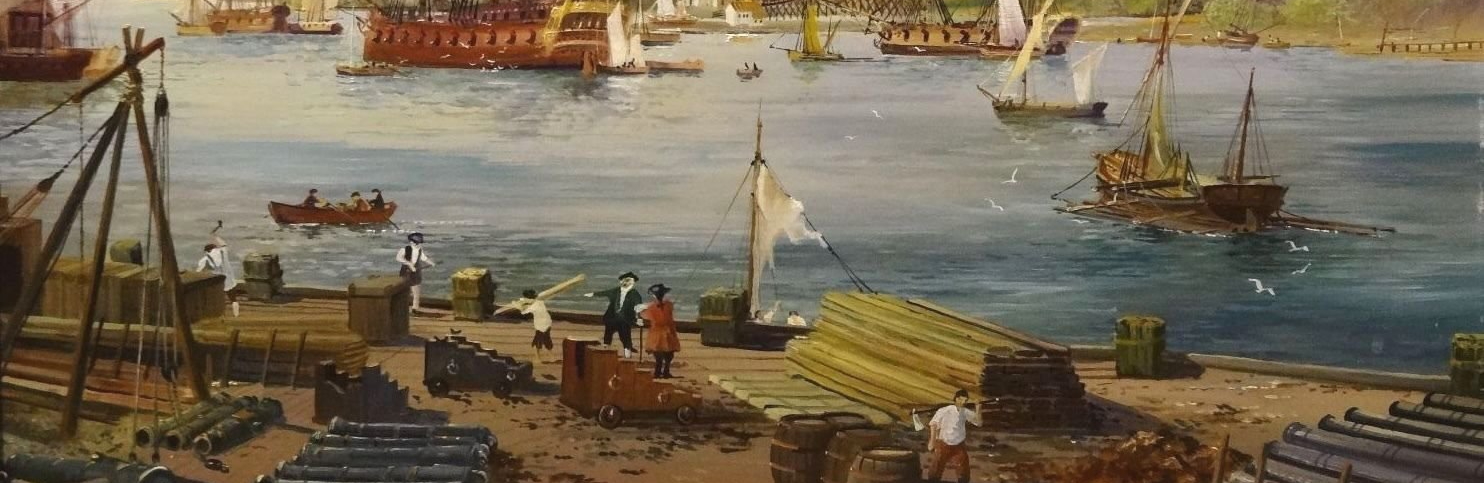
Our backdrop to this story was Portsmouth in 1834, where we were part of a group – the Gunwharf Ants – who worked as stevedores and made our living (on top of the abysmal wages for
manual handling) through the criminal pursuit of “skimming a little off the top” of the bulk-break cargo we moved between ships and onto and off the canal. These stolen goods would be
hidden in the basement of nearby pub The Duke of Wellington until they could be safely fenced, and this often-lucrative enterprise made us the envy of many of the docklands’ other
criminal gangs.
I played Katie – “Kegs” to her friends – the proprietor of the Duke (since her husband’s death) and matriarch of the group. I was joined by Nuek (Alec), a Scandinavian friend with a wealth of criminal experience, John “Tuck” Crawford (Matt), adoptee of the gang and our aspiring quartermaster, and
“Yellow” Mathias Hammond (Simon), a navy deserter who consistently delivers better than he expects to.
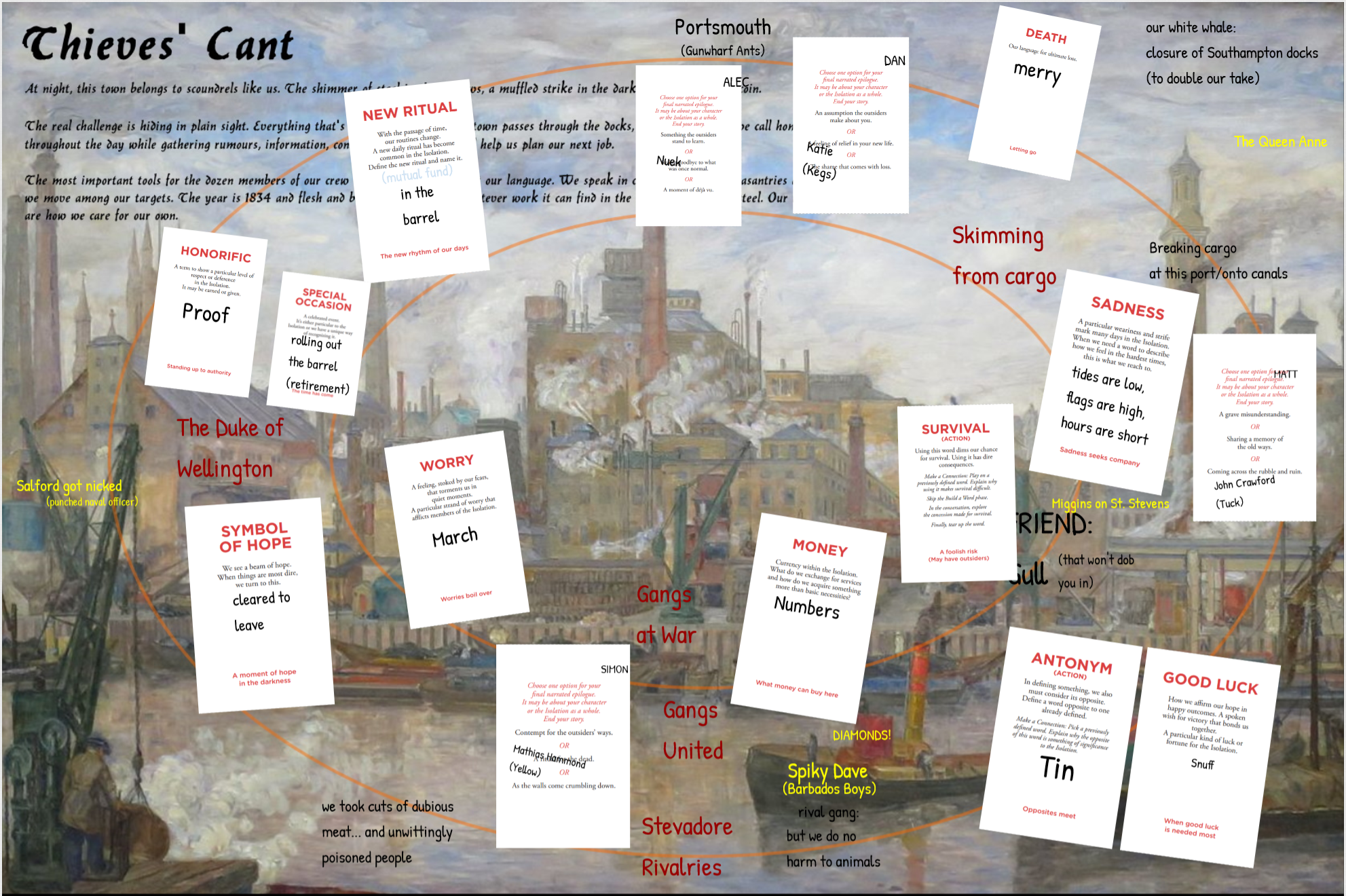
Our second tableau was somehow more-chaotic than the first, even after I accidentally removed several cards before taking this picture!
While each of us had our stories and some beautiful and hilarious moments, I felt that we all quickly converged on the idea that the principal storyline in our isolation was that of
young Tuck. The first act was dominated by his efforts to proof himself to the gang, and – with a little snuff – shake off his reputation as the “kid” of the group and
gain acceptance amongst his peers. His chance to prove himself with a caper aboard the Queen Anne went proper merry though after she turned up tin-ful and he found
himself kept in a second-place position for years longer. Tuck – and Yellow – got proofed eventually, but the extra time spent living hand-to-mouth might have been what first
planted the seed of charity in the young man’s head, and kept most of his numbers out of his pocket and into those of the families he supported in the St. Stevens area.
The second act turned political, as Spiky Dave, leader of the competing gang The Barbados Boys, based over Gosport way, offered a truce between the two rivals in exchange for sharing
the manpower – and profits – of a big job against a ship from South Africa… with a case of diamonds aboard. Disagreements over the deal undermined Kegs’ authority over the Ants, but
despite their March it went ahead anyway and the job was a success. Except… Spiky Dave kept more than his share of the loot, and agreed to share what was promised only in
exchange for the surrender of the Ants and their territory to his gang’s rulership.
We returned to interpersonal drama in the third act as Katie – tired of the gang wars and feeling her age – took perhaps more than her fair share of the barrel (the gang’s
shared social care fund) and bought herself clearance to leave aboard a ship to a beachside retirement in Jamaica. She gave up her stake in the future of the gang and
shrugged off their challenges in exchange for a quiet life, leaving Nuek as the senior remaining leader of the group… but Tuck the owner of the Duke of Wellington. The gang split into
those that integrated with their rivals and those that went their separate ways… and their curious pidgin dissolved with them. Well, except for a few terms which hung on in dockside
gang chatter, screeched amongst the gulls of Portsmouth without knowing their significance, for years to come.
Playing Out
Despite being fundamentally the same game and a similar setting to when we played The Outpost the previous month, this game felt very different. Dialect is
versatile enough that it can be used to write… adventures, coming-of-age tales, rags-to-riches stories, a comedies, horror, romance… and unless the tone is explicitly set out at the
start then it’ll (hopefully) settle somewhere mutually-acceptable to all of the players. But with a new game, new setting, and new players, it’s inevitable that a different kind of
story will be told.
But more than that, the backdrop itself impacted on the tale we wove. On Mars, we were physically isolated from the rest of humankind and living in an environment in which the
necessities of a new lifestyle and society necessitates new language. But the isolation of criminal gangs in Portsmouth docklands in the late Georgian era is a very different
kind: it’s a partial isolation, imposed (where it is) by its members and to a lesser extent by the society around them. Which meant that while their language was still a defining aspect
of their isolation, it also felt more-artificial; deliberately so, because those who developed it did so specifically in order to communicate surreptitiously… and, we
discovered, to encode their group’s identity into their pidgin.
While our first game of Dialect felt like the language lead the story, this second game felt more like the language and the story co-evolved but were mostly unrelated. That’s
not necessarily a problem, and I think we all had fun, but it wasn’t what we expected. I’m glad this wasn’t our first experience of Dialect, because if it were I think
it might have tainted our understanding of what the game can be.
As with The Outpost, we found that some of the concepts we came up with didn’t see much use: on Mars, the concept of fibs was rooted in a history of of how our medical
records were linked to one another (for e.g. transplant compatibility), but aside from our shared understanding of the background of the word this storyline didn’t really come up.
Similarly, in Thieves Cant’ we developed a background about the (vegan!) roots of our gang’s ethics, but it barely got used as more than conversational flavour. In both cases
I’ve wondered, after the fact, whether a “flashback” scene framed from one of our prompts might have helped solidify the concept. But I’m also not sure whether or not such a thing would
be necessary. We seemed to collectively latch onto a story hook – this time around, centred around Matt’s character John Crawford’s life and our influences on it – and it played out
fine.
And hey; nobody died before the epilogue, this time!
I’m looking forward to another game next time we’re on a D&D break, or perhaps some other time.
Dr. Doe’s latest Sexplanations vlog is on polyamorous language, and despite being – or, perhaps, because I’m – a bit of a long-toothed polyamorist these days, fully a quarter
or more of the terms she introduced were new to me! Fascinating!
Enfys published an article this week to their personal blog: How to use gender-inclusive language. It spun out from a post that they co-authored on an internal Automattic blog, and while the while thing is pretty awesome as a primer for anybody you need to show it to, it introduced a new word to my lexicon for
which I’m really grateful.
The Need for a New Word
I’ve long bemoaned the lack of a gender-neutral term encompassing “aunts and uncles” (and, indeed, anybody else in the same category: your parents’ siblings and their spouses). Words
like sibling have been well-established for a century or more; nibling has gained a lot of
ground over the last few decades and appears in many dictionaries… but we don’t have a good opposite to nibling!
Why do we need such a word?
As a convenient collective noun: “I have 5 aunts and uncles” is clumsier than it needs to be.
Where gender is irrelevant: “Do you have and aunts and/or uncles” is clumsier still.
Where gender is unknown: “My grandfather has two children: my father and Jo.” “Oh; so you have an Aunt or Uncle Jo?” Ick.
Where gender is nonbinary: “My Uncle Chris’s spouse uses ‘they/them’ pronouns. They’re my… oh fuck I don’t even remotely have a word for this.”
New Words I Don’t Like
I’m not the first to notice this gap in the English language, and others have tried to fill it.
I’ve heard pibling used, but I don’t like it. I can see what its proponents are trying to do: combine
“parent” and “sibling” (although that in itself feels ambiguous: is this about my parents’ siblings or my siblings’ parents, which aren’t necessarily the same thing). Moreover, the
-ling suffix feels like a diminutive, even if that’s not its etymological root in this particular case, and it feels backwards to use a diminutive to describe somebody
typically in an older generation than yourself.
I’ve heard that some folks use nuncle, and I hate that word even more. Nuncle already has a meaning, albeit an archaic
one: it means “uncle”. Read your Shakespeare! Don’t get me wrong: I’m all for resurrecting useful archaic words: I’m
on a personal campaign to increase use eyeyesterday and, especially, overmorrow (German has übermorgen, Afrikaans has
oormôre, Romanian has poimâine: I want a word for “the day
after tomorrow” too)! If you bring back a word only to try to define it as almost-the-opposite of what you want it to mean, you’re in for trouble.
Auntle is another candidate – a simple fusion of “aunt” and “uncle”… but it still feels a bit connected to the gendered terms it comes from, plus if you look around enough you
find it being used for everything from an affectionate mutation of “aunt” to a term to refer to your uncle’s husband. We can do better.
A New Word I Do!
But Enfys’ post gave me a new word, and I love it:
…
Here are some gender-neutral options for gendered words we hear a lot. They’re especially handy if you’re not sure of the gender of the person you’re addressing:
Mx.: An honorific, alternative to Mr./Mrs./Ms.
Sibling: instead of brother/sister
Spouse: instead of husband/wife
Partner, datefriend, sweetheart, significant other: instead of boyfriend/girlfriend
Parent: instead of mother/father
Nibling: instead of niece/nephew
Pibling, Entle, Nuncle: instead of aunt/uncle
…
Entle! Possibly invented here, this is the best gender-neutral term for “the sibling of your
parents, or the spouse of the sibling of your parents, or another family member who fulfils a similar role” that I’ve ever seen. It brings “ent” from “parent” which, while
etymologically the wrong part of the word for referring to blood relatives (that comes from a PIE root pere- meaning “to produce or bring forth”), feels similar to the contemporary slang root rent (clipped form of “parent”).
It feels new and fresh enough to not be “auntle”, but it’s similar enough to the words “aunt” and “uncle” that it’s easy to pick up and start using without that “what’s that new word I
need to use here?” moment.
I’m totally going to start using entle. I’m not sure I’ll find a use for it today or even tomorrow. But overmorrow? You never know.
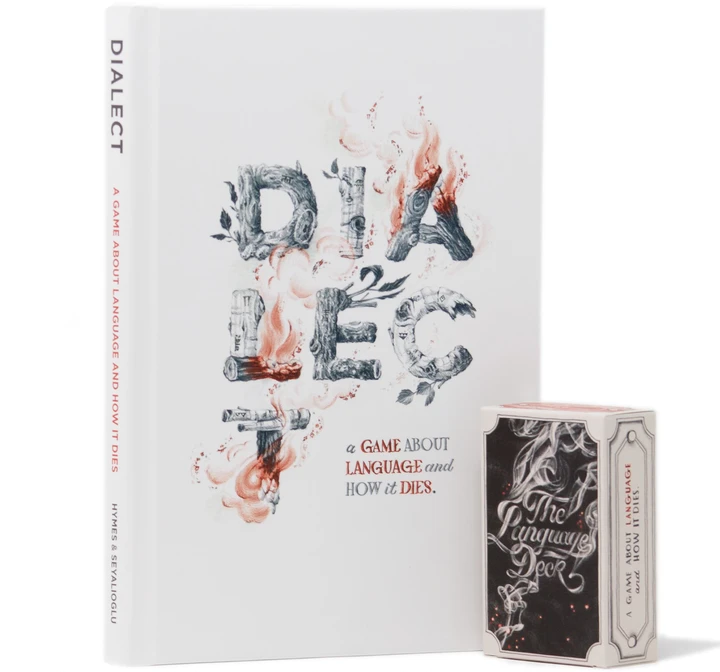
Dialect could be described as a rules-light, GM-less (it has a “facilitator” role, but they have no more authority than any player on
anything), narrative-driven/storytelling roleplaying game based on the concept of isolated groups developing their own unique dialect and using the words they develop as a vehicle to
tell their stories.
It’s also super-pretty to leaf through and hold.
This might not be the kind of RPG that everybody likes to play – if you like your rules more-structured, for example, or
you’re not a fan of “one-shot”/”beer and pretzels” gaming – but I was able to grab a subset of our usual roleplayers – Alec, Matt R, Penny, and
I – and have a game (with thanks to Google Meet for videoconferencing and Roll20 for the virtual tabletop: I’d have used Foundry but its card support is still pretty terrible!).
The Outpost
A game of Dialect begins with a backdrop – what other games might call a scenario or adventure – to set the scene. We opted for The Outpost, which put the four of us
among the first two thousand humans to colonise Mars, landing in 2045. With help from some prompts provided by the backdrop we expanded our situation in order to declare the “aspects”
that would underpin our story, and then expand on these to gain a shared understanding of our world and society:
Refugees from plague: Our expedition left Earth to escape from a series of devastating plagues that were ravaging the planet, to try to get a fresh start on another
world.
Hostile environment: Life on Mars is dominated by the ongoing struggle for sufficient food and water; we get by, but only thanks to ongoing effort and discipline and
we lack some industries that we haven’t been able to bootstrap in the five years we’ve been here (we had originally thought that others would follow).
Functionalist, duty-driven society: The combination of these two factors led us to form a society based on supporting its own needs; somewhat short of a caste system,
our culture is one of utilitarianism and unity.
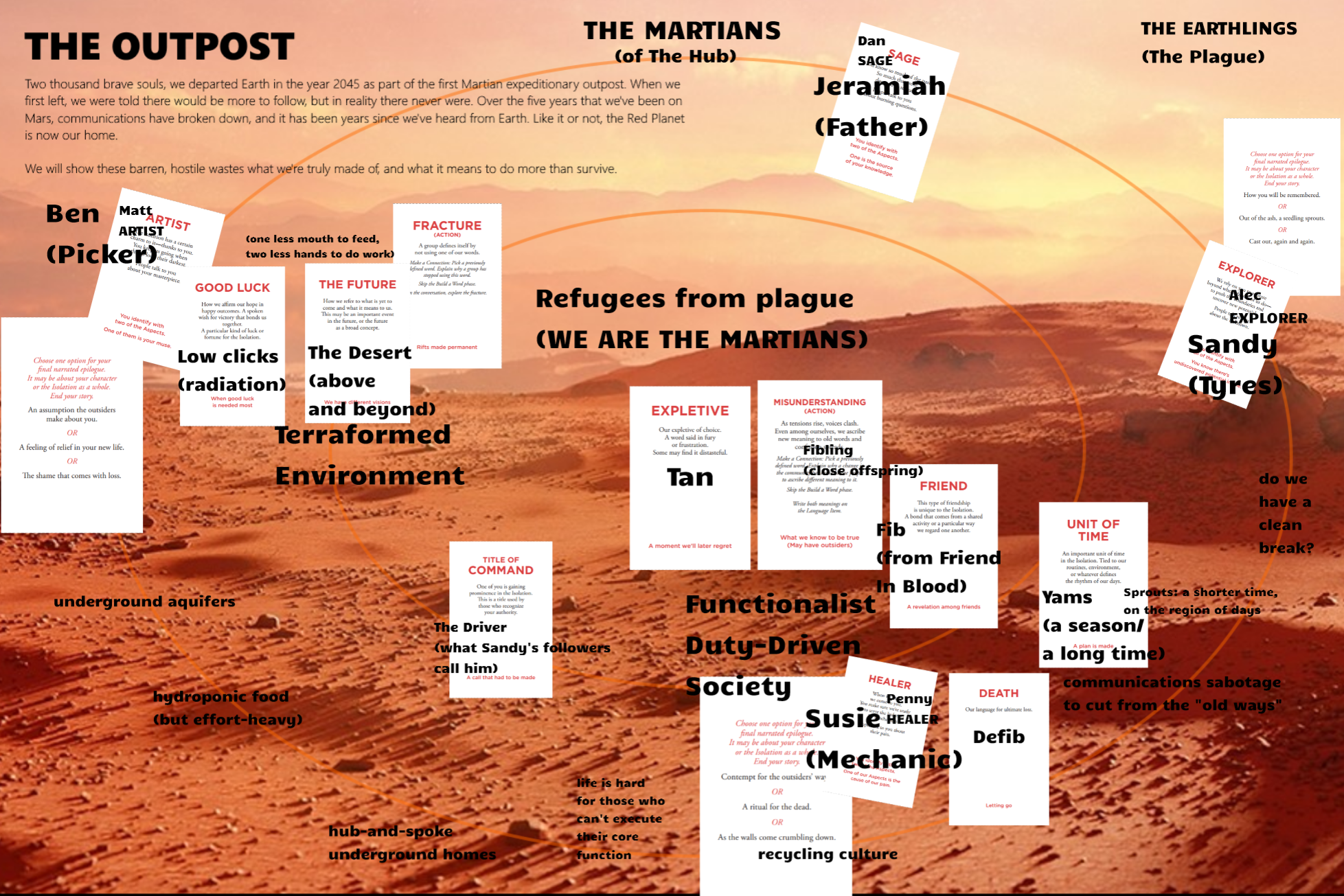
Our finished game board, or tableau.
It soon became apparent that communication with Earth had been severed, at least initially, from our end: radicals, seeing the successes of our new social and economic systems,
wanted to cement our differences by severing ties with the old world. And so our society lives in a hub-and-spoke cave system beneath the Martian desert, self-sustaining except for the
need to send rovers patrolling the surface to scout for and collect valuable surface minerals.
In this world, and prompted by our cards, we each developed a character. I was Jeramiah, the self-appointed “father” of the expedition and of this unusual new social order, who
remembers the last disasters and wars of old Earth and has revolutionary plans for a better world here on Mars, based on controlled growth and a planned economy. Alec played Sandy –
“Tyres” to their friends – a rover-driving explorer with one eye always on the horizon and fresh stories for the colony brought back from behind every new crater and mountain. Penny
played Susie, acting not only as the senior medic to the expedition but something more: sort-of the “mechanic” of our people-driven underground machine, working to keep alive the
genetic records we’d brought from Earth and keep them up-to-date as our society eventually grew, in order to prevent the same kinds of catastrophe happening here. “Picker” Ben was our
artist, for even a functionalist society needs somebody to record its stories, celebrate its accomplishments, and inspire its people. It’s possible that the existence of his position
was Jeramiah’s doing: the two share a respect for the stark, barren, undeveloped beauty of the Martian surface.
We developed our language using prompt cards, improvised dialogue, and the needs of our society. But the decades that followed brought great change. More probes began to land from
Earth, more sophisticated than the ones that had delivered us here. They brought automated terraforming equipment, great machines that began to transform Mars from a barren wasteland
into a place for humans to thrive. These changes fractured our society: there were those that saw opportunity in this change – a chance to go above ground and live in the sun, to expand
across the planet, to make easier the struggle of our day-to-day lives. But others saw it as a threat: to our way of life, which had been shaped by our challenging environment; to our
great social experiment, which could be ruined by the promise of an excessive lifestyle; to our independence, as these probes were clearly the harbingers of the long-promised second
wave from Earth.
Even as new colonies were founded, the Martians of the Hub (the true Martians, who’d been here for yams time, lived and defibed here, not these tanning desert-dwelers that
followed) resisted the change, but it was always going to be a losing battle. Jeramiah took his last breath in an environment suit atop a dusty Martian mountain a day’s drive from the
Hub, watching the last of the nearby deserts that was still untouched by the new green plants that had begun to spread across the surface. He was with his friend Sandy, for despite all
of the culture’s efforts to paint them as diametrically opposed leaders with different ideas of the future, they remained friends until the end. As the years went by and more and more
colonists arrived, Sandy left for Phobos, always looking for a new horizon to explore. Sick of the growing number of people who couldn’t understand his language or his art, Ben
pioneered an expedition to the far side of the planet where he lived alone, running a self-sustaining agri-home and exploring the hills until his dying day. We were never sure where
Susie ended up, but it wasn’t Mars: she’d talked about joining humanity’s next big jump, to the moons of Jupiter, so perhaps she’s out there on one of the colonies of Titan or Europa.
Maybe, low clicks, she’s even keeping our language alive out there.
Retrospective
The whole event was a lot of fun and I’m keen to repeat it, perhaps with a different group and a different backdrop. The usual folks know who they are, but if you’re not one of
those and you want in next time we play, drop me a message of some kind.
What this now does is instead of saying “add margin to the left”, it says “regardless of direction, put margin on the starting side”. If the language of the document was
right to left, like Arabic, that margin would be on the right hand side.
…
This is clever. If you use e.g. margin-left on every list element after the first to put space “between” them, the spacing isn’t quite right when the order of the elements
is reversed, for example because your page has been automatically translated into a language that reads in the opposite direction (e.g. right-to-left, rather than left-to-right). When
you use margin-left in this way you’re imposing a language-direction-centric bias on your content, and there’s no need: margin-inline-start and its friends
are widely-supported and says what you mean: “place a margin before this element”. I’ll be trying to remember to
use this where it’s appropriate from now on.
I had a bit of a realisation, this week. I’ve long sometimes found it especially challenging to maintain a mental map of the preferred personal pronouns of people who don’t use “he”,
“she”, or “they”. Further than that, it seemed to me that personal pronouns beyond these three ought to be mostly redundant in English. “Them” has been well-established for over six centuries as not just a plural but a singular pronoun, I thought: we don’t need
to invent more words.
Over time – even within my lifetime – it’s become noticeably more-commonplace to hear the singular “they”/”them” in place of
“he or she”/”him or her”, or single binary pronouns (e.g. when talking about professions which have long been dominated by a particular gender). So you might hear somebody say:
“I will make an appointment to see a doctor and ask them about my persistent cough.”
This seemed a perfectly viable model.
It seemed to me that “they” was a perfect general-purpose stand in for everybody who was well-served by neither “he” nor “she”.
I’ll stress, of course, that I’ve always been fully supportive of people’s preferred pronouns, tried to use them consistently, ensured they can be
represented in software I’ve implemented (and pressured others over their implementations, although that’s as-often related to my individual identity), etc. I’ve just struggled to see the need for new singular third-person pronouns like ze,
ey, sie, ve, or – heaven forbid – the linguistically-cumbersome thon, co, or peh.
I’d put it down to one of those things that I just don’t “get”, but about which I can still respect and support anyway. I don’t have to totally grok something in order to understand
that it’s important to others.
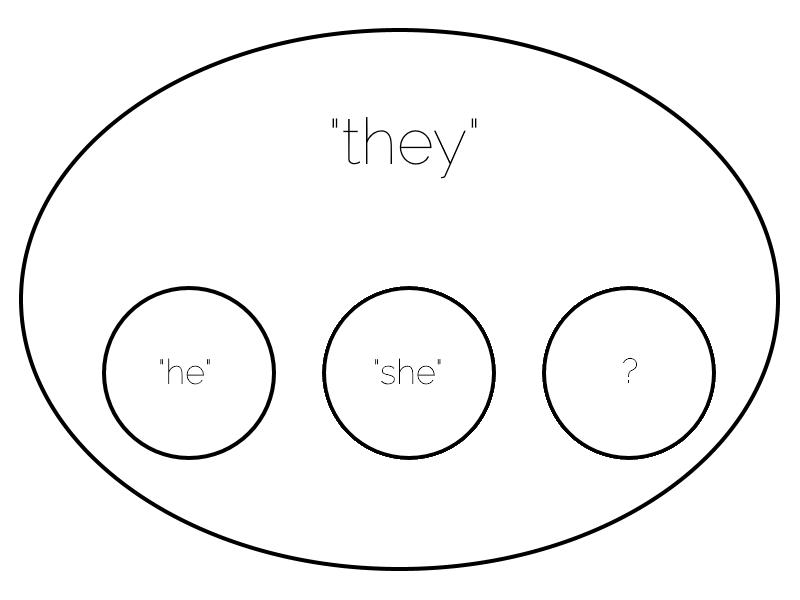
Hang on, there’s a problem with this model.
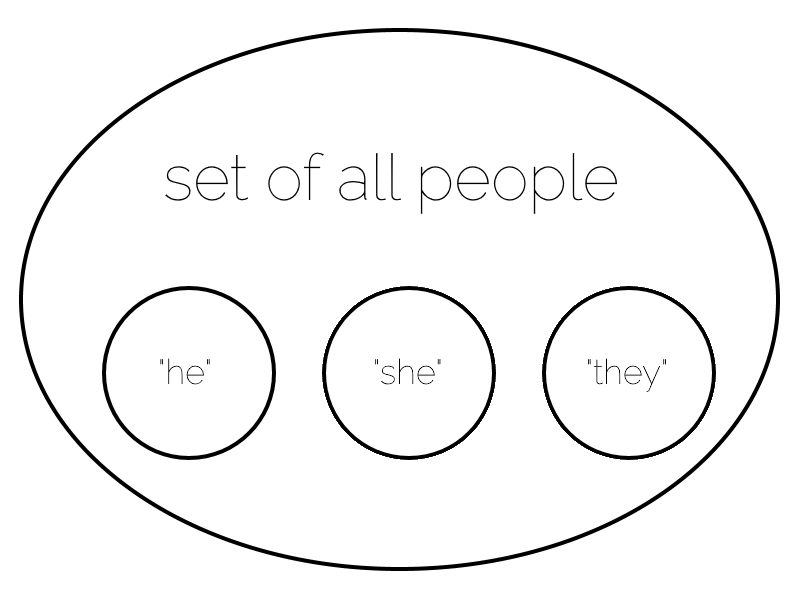
But very recently, I was suddenly struck by a comprehension of one of the reported problems with the use of the singular “they” to refer to people for whom the traditional binary
pronouns are not suitable. I’ve tried to capture in the illustration above the moment of understanding when I made the leap.
The essence of this particular problem is: the singular “they” already has a meaning that is necessarily incompatible with the singular “they” used of a nonbinary
subject! By way of example, let’s revisit my earlier example sentence:
“I will make an appointment to see a doctor and ask them about my persistent cough.”
Here, I’m saying one of two things, and it’s fundamentally unclear which of the two I mean:
I do not know which doctor I will see, so I do not know the pronoun of the doctor.
I will see the same doctor I always see, and they prefer a nonbinary pronoun.
The more widespread the adoption of “they” as the third person singular for nonbinary people becomes, the more long-winded it is to clarify specifically which of the above
interpretations is correct! The tendency to assume the former leads to nonbinary invisibility, and the (less-likely in most social circles) tendency to assume the latter leads to
misgendering.
Okay, so I guess we do need a third-party singular pronoun that isn’t “they”.
The difference is one of specificity. Because the singular “they” is routinely used non-specifically, where the subject’s preferred pronouns are unknown (as with the doctor, above),
unknowable (“somebody wrote this anonymous message; they said…”), or a placeholder (“when I meet somebody, I shake their hand”), it quickly produces
semantic ambiguities when it’s used to refer to specific nonbinary individuals. And that makes me think: we can do better.
That said: I don’t feel able to suggest which pronoun(s) ought to replace the question mark in the diagram above. But for the first time, I’m not convinced that it ought to be “they”.
Ultimately, this changes nothing. I regularly use a diversity of different singular pronouns (he”, “she”, and “they”, mostly) based on the individual subject and I’ll continue to
acknowledge and respect their preferences. If you’ve you’ve told me that you like to be referred to by the singular “they”, I’ll continue to do so and you’re welcome and
encouraged to correct me if I get it wrong!
But perhaps this new appreciation of the limitations of the singular “they” when referring to specific individuals will help me to empathise with those for whom it doesn’t feel
right, and who might benefit from more-widespread understanding of other, newer personal pronouns.
(and on the off chance anybody’s found their way to this page looking for my pronouns: I’m not particularly fussy, so long as you’re consistent and don’t confuse your
audience, but most people refer to me with traditional masculine pronouns he/him/his)
It’s likely that the first word ladder puzzles were created by none other than Lewis Carroll (Charles Lutwidge Dodgson), the talented British mathematician, and author of the Alice’s
adventures. According to Carroll, he invented them on Christmas Day in 1877.
A word ladder puzzle consists of two end-cap words, and the goal is to derive a series of chain words that change one word to the other. At each stage, adjacent words on the ladder
differ by the substitution of just one letter. Each chain word (or rung of the word ladder), also needs to be a valid word. Below is an example of turning TABLE into CROWN (this time,
in nine steps):
In another example, it take four steps to turn WARM into COLD.
WARM → WARD → CARD → CORD → COLD
(As each letter of the two words in the last example is different, this is the minimum possible number of moves; each move changes one of the letters).
Word ladders are also sometimes referred to as doublets, word-links, paragrams, laddergrams or word golf.
…
Nice one! Nick Berry does something I’ve often considered doing but never found the time by “solving” word ladders and finding longer chains than might have ever been identified before.