But more seriously, my mission – if I have such a thing, is:
Today’s my first day back at work after an decent length break (if you exclude the Friday after Christmas, when I did a little, I’ve
been away from my day job for over a fortnight), and I’ve got a lot to catch up on even before I kick off running a training course I’ve never delivered before, so that’s all
you get for today. But so long as my Bloganuary streak (which now almost makes it onto my leaderboard!)
continues, I’m counting this as a win.
You may remember that I was excited to hear about the upcoming release of Dune (which I
suppose should be called Dune: Part One). It turns out to be excellent and I’d recommend it to anybody.
But once you’ve seen it and while you’re in the two-year wait for Dune: Part Two (argh!), can I suggest you also enjoy this wonderful creation by the folks at Bad Lip Reading,
whose work I’ve plugged before. Note: minor spoilers (amazingly) if you haven’t seen
Dune yet.
I’ve a long history of blogging about dreams I’ve had, and though I’ve not done so recently I don’t want you to think it’s because my dreams have gotten any
less trippy-as-fuck. Take last night for example…
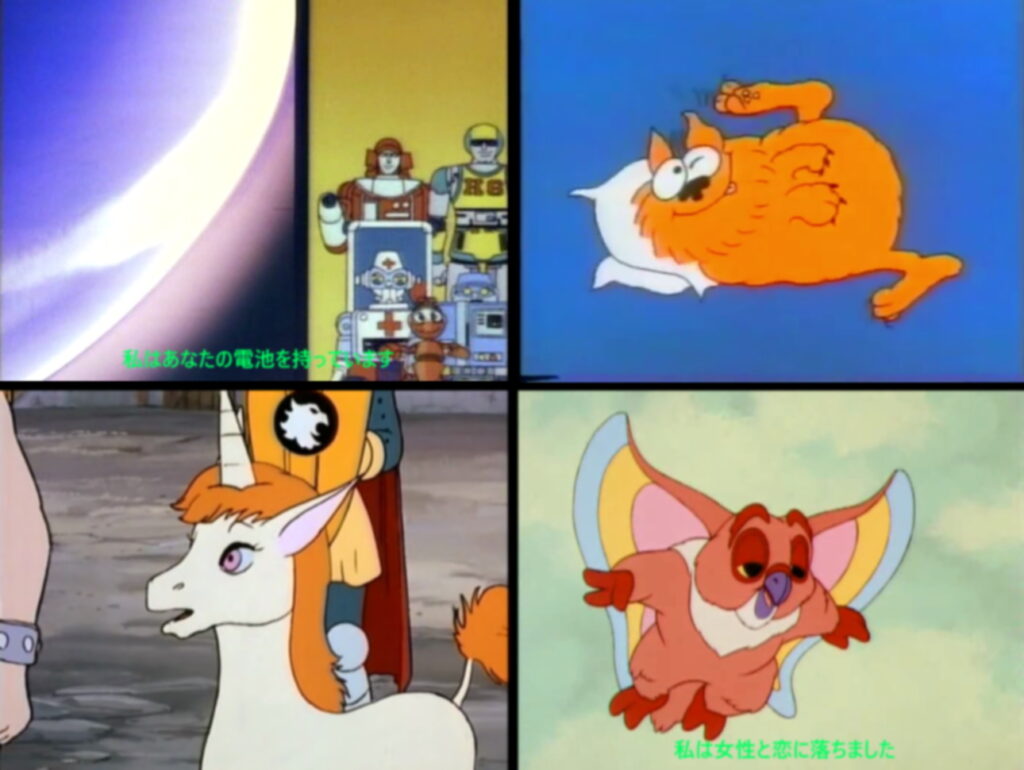
I plough every penny and spare minute I can into a side-project that in my head at least qualifies as “art”. The result will be fake opening credits animation for the (non-existent)
pilot episode of an imagined 80s-style children’s television show. But it gets weirder.
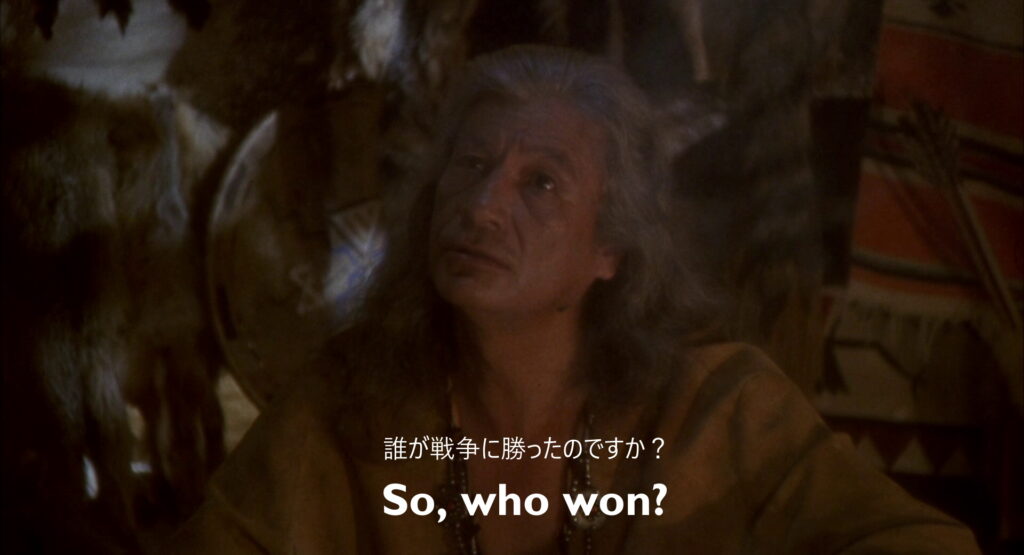
Do you remember Hot Shots!? There’s this scene near the end where Topper Harley, played by Charlie Sheen, returns to the Native
American tribe he’s been living with since before the film (in sort of a clash between the “proud warrior
race” trope and a parody of Dances With Wolves, which came out the previous year). Returning to his teepee, Topper meets tribal
elder Owatonna (Rino Thunder), who asks him about the battle Topper had gone to fight in and, in a callback to an earlier joke, receives the four AA-cell batteries he’d asked Topper
to pick up for him “while he was out”.
There are very few occasions where a parody film is objectively better than it’s source material, but I maintain that Hot Shots! beats Top Gun hands-down.
I take the dialogue from this scene (which in reality is nonsense, only the subtitles give it any meaning),
mangle it slightly, and translate it into Japanese using an automated translation service. I find some Japanese-speaking colleagues to help verify that each line broadly makes sense,
at least in isolation.
I commission the soundtrack for my credits sequence. A bit of synth-pop about a minute long. I recruit some voice actors to read each of my Japanese lines, as if they’re characters in
an animated kids TV show. I mix it together, putting bits of Japanese dialogue in the right places so that if anybody were to sync-up my soundtrack with the correct scene in Hot
Shots!, the Japanese dialogue would closely mirror the conversation that the characters in that film were having. The scene, though, is slow-paced enough that, re-recorded, the voices
in my new soundtrack don’t sound like they’re part of the same conversation as one another. This is deliberate.
Meanwhile, I’ve had some artists put together some concept character art for me, based on some descriptions. There’s the usual eclectic mix of characters that you’d expect from 80s
cartoons: one character’s a friendly bear-like thing, another’s a cowardly robot, there’s a talking flying unicorn… you know the kind of shit. I give them descriptions, they give me
art.
Next, I send the concept art and the soundtrack to an animation team and ask them to produce a credits sequence for it, and I indicate which of the characters depicted should be
saying which lines.
Identifying the shows I lifted images from to make this sample is left as an exercise for the reader.
Finally, I dump the credits sequence around the Internet, wait a bit, and then start asking on forums “hey, what show is this?” to see what kind of response it gets.
The thing goes viral. It scratches the itch of people who love to try to find the provenance of old TV clips, but of course there’s no payoff because the show doesn’t exist. It
doesn’t take too long before somebody translates the dialogue and notices some of the unusual phasing and suggests a connection to Hot Shots! That seems to help date the show as
post-1991, but it’s still a mystery. By the time somebody get around to posting a video where the soundtrack overlays the scene from Hot Shots!, conspiracy theories are already all
over: the dominant hypothesis is that the clips are from a series of different shows (still to be identified) but only the soundtrack is new… but that still doesn’t answer what the
different shows are!
As the phenomenon begins to expand into mainstream media I become aware that even the most meme-averse folks I know are going to hear about it, at some point. And as I ‘m likely to be
“found out” as the creator of this weird thing, sooner or later, I decide to come clean about it to people I know sooner, rather than later. I’m hanging out with Ruth and her brothers Robin and Owen and I bring it up:
“Do you remember Hot Shots!? There’s this scene near the end where Topper Harley, played by Charlie Sheen…”, I begin, hoping that the explanation of my process might somehow justify
the weird shit I’ve brought to the world. Or at least, that one of this group has already come across this latest Internet trend and will interject and give me an “in”.
Ruth interrupts: “I don’t think I’ve seen Hot Shots!”
“Really?” Realising that this’ll take some background explanation, I begin by referring to Top Gun and the tropes Hot Shots! plays into and work from there.
Some time later, I’m involved with a team who are making a documentary about the whole phenomenon and my part in it. They’re proposing to release a special edition disc with a chapter
that uses DVD video’s “multi angle” and “audio format switch” features to allow you to watch your choice of either the scene from
Hot Shots! or from my trailer with your choice of either the original audio, my soundtrack, or a commentary by me, but they’re having difficulty negotiating the relevant rights.
After I woke, I tried to tell Ruth about this most-bizarre dream, but soon got stuck in an “am I still dreaming” moment after the following exchange:
Sometimes, I miss Troma Night. Hanging out with my friends and watching awful/awesome films over pizza and beer.
If only there were a way to do it during lockdown?
Oh wait, there is: danq.me/homa-night/homa-night-2
Oh my god I’m so excited. I’m afraid they might fuck up the story even more than David Lynch did in 1984 (not that I don’t
love that film, too, but in a very different way than the books). I mean: I’d have hoped a modern adaptation would have a bigger part for Chani than it clearly does. And I know nothing at all about the lead,
Timothée Chalamet. If only there was something I could do about these fears?
I must not fear. Fear is the mind-killer. Fear is the little-death that brings total obliteration. I will face my fear. I will permit it to pass over me and through me. And when it
has gone past I will turn the inner eye to see its path. Where the fear has gone there will be nothing. Only I will remain.
Yeah, that’s the kind of thing.
The supporting cast look excellent. I think Josh Brolin will make an awesome Gurney Halleck, Jason Momoa will rock Duncan Idaho, and I’m looking forward to seeing Stephen
McKinley Henderson play Thufir Hawat. But if there’s just one thing you should watch the trailer for… it’s to listen to fragments of Hans Zimmer’s haunting, simplistic choral
adaptation of Pink Floyd’s Eclipse.
It’s one of the best visual gags in a movie filled with them.
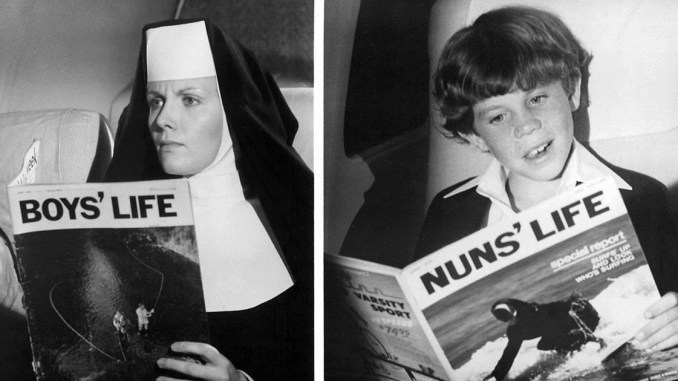
In the classic 1980 comedy Airplane!, two passengers are seen reading magazines. First, we see a nun reading Boys’ Life. Moments later, there’s
a boy reading Nuns’ Life.
The scene is over in seconds, but the memory of this joke lives on. That’s especially true for those of us who have been reading Boys’ Life since we were
kids.
Here are seven things you might not know about this bit of visual humor.
…
Of the many things I love, here are two of them:
The Airplane series of movies.
People who, like me, get carried away researching something trivial and accidentally become an expert in a miniscule field.
This fantastic piece takes a deep dive into a tiny scene in Airplane. What issue of Boys’ Life was the nun reading? What page was she looking at? What actual magazine
was the boy reading within the Nuns’ Life cover? These and more questions you never thought about before are answered!
This beautifully-shot short film won Best Live Action Short Film at the Oscars last month, and if you haven’t seen it you owe it to yourself to do so. Over the course of 20
artfully-crafted minutes it tells two distinct stories, and before long you realise that what you’re really watching is the third story that emerges, Rubin vase-style,
from the mind of the watcher and in the gaps between the two. Official website. Probably NSFW.
After 8 or 10 (depending on how you count them) films and hundreds of hours of TV, finally we have reached the end of the whole Star Wars saga. Hooray,…
Exactly my thoughts on the latest Star Wars films, concisely expressed.
You could fit almost the entire history of videogames into the time span covered by the silent film era, yet we consider it a mature medium, rather than one just breaking out of its
infancy. Like silent movies, classic games are often incomplete, damaged, or technically limited, but have a beauty all their own. In this spirit, indie game developer Joe Blair and I
built Metropoloid, a remix of Fritz Lang’s Metropolis which replaces its famously lost score with that of its contemporaries from the early days of games.
I’ve watched Metropolis a number of times over the decades, in a variety of the stages of its recovery, and I
love it. I’ve watched it with a pre-recorded but believed-to-be-faithful soundtrack and I’ve watched it with several diolive accompaniment. But this is the first time I’ve watched it to
the soundtrack of classic (and contemporary-retro) videogames: the Metroid, Castlevania, Zelda, Mega Man and Final Fantasy
series, Doom,Kirby, F-Zero and more. If you’ve got a couple of hours to spare and a love of classic film and classic videogames, then you’re in
the slim minority that will get the most out of this fabulous labour of love (which, at the time of my writing, has enjoyed only a few hundred views and a mere 26 “thumbs up”: it
certainly deserves a wider audience!).
In the future, media organizations might have to do away with the “film” and “TV” tags entirely, if indeed there are media organizations as we currently think of them.
…
Based on my own experience chronicling both art forms, I’m increasingly convinced that film and TV started merging a long time ago, before most of us were aware of what was going
on. Some of us have accepted the change. Others are in denial about it. But as my grandfather used to say, there’s no point trying to close the barn doors after the horses have
already escaped.
…
Interesting article summarising the ongoing changes to the concepts of what we consider “film” versus “television” and the increasingly blurred distinction, and an exploration of how
that’s embodied by phenomena like Avengers: Endgame and the final series of Game of Thrones. Spoilers about the former and about the first three episodes of the
latter, obviously.
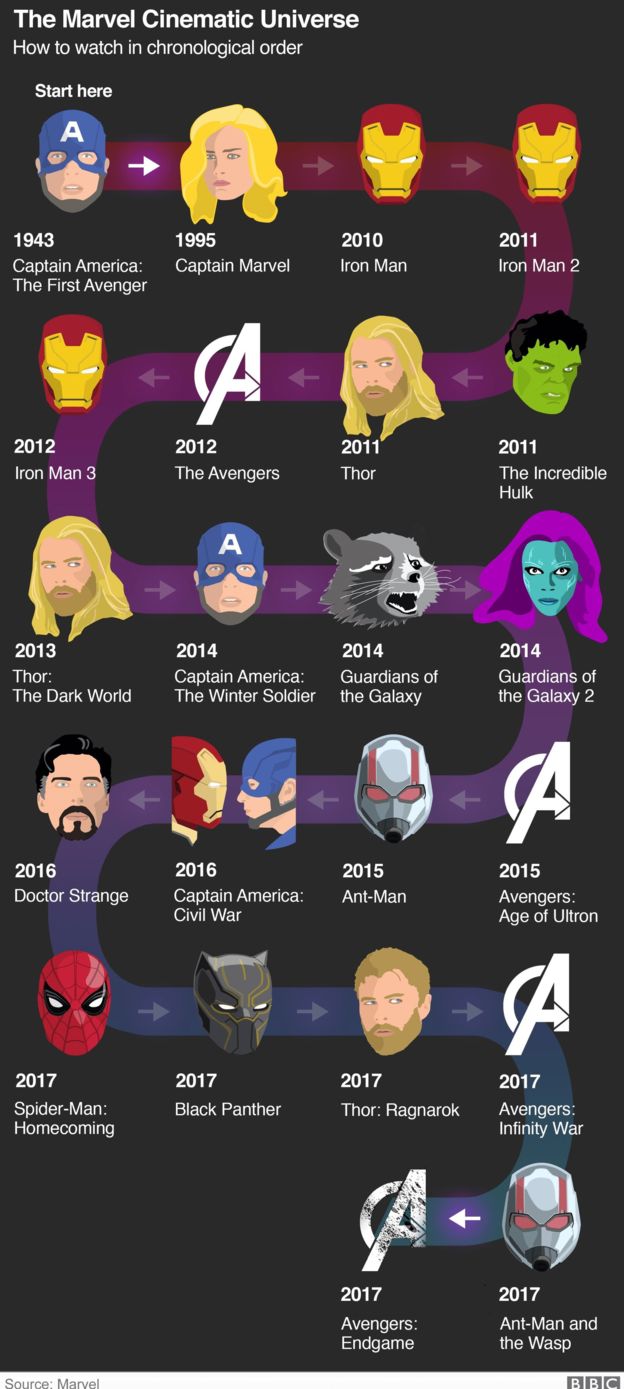
Who’s for a rewatch of the entire Marvel Cinematic Universe, in the “correct” order, before Endgame? No?
The thinking behind this infographic (and in particular the shuffling of Ant-Man and the Wasp behind Infinity War) is like an even bigger, possibly-nerdier
variant of the kind of thinking that lead to Star Wars – Machete Order.
 a
a body
body canvas